
"I started too late, didn't I?"
Which format grows your game fastest?
I hear this almost every week. Adults who doubt themselves, parents wondering if they missed the window for their child, teenagers afraid they are already too old. The answer is always the same: age isn't the variable that decides your ceiling. The quality of the framework you build is.
The students I see improve fastest didn't all start at six. They are the ones who found a steady rhythm, a clear priority, and a method that closes the loop between what they study and what they actually play. I have seen forty-year-olds go from 800 to 1600 in eighteen months because they worked cleanly. I have also seen players who learned at seven plateau at 1200 for years because they played endlessly without ever analyzing anything.
Starting as a child gives familiarity, not a guarantee
A child who learns chess between five and ten installs something that late starters will need to rebuild later: visual familiarity with the board. Squares, diagonals, piece coordination patterns become almost intuitive, a bit like a native language compared to one learned as an adult. That familiarity helps, and it explains why most very strong players learned young.
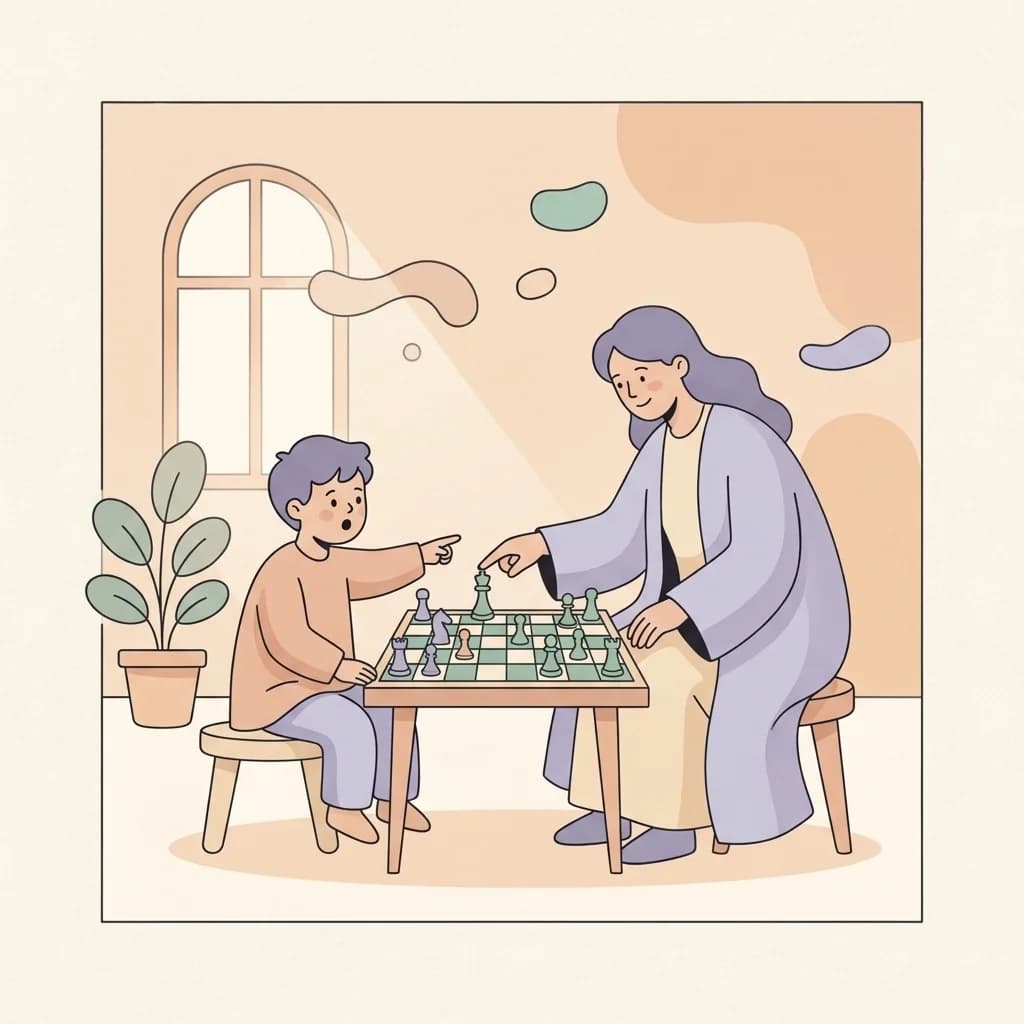
But familiarity alone guarantees nothing. A child who plays ten minutes a week with no guidance stays a beginner for years. A child pushed too early into abstract theory often loses interest before extracting anything from it. What works at this age is playing with simple rules, short positions, an adult who comments without judging, and regular exposure with no pressure.
The right question for a child isn't "at what age should I start?" but "does he or she enjoy it?". If yes, and the environment is healthy, the child can go very far. If no, pushing produces the opposite of what you want. The cognitive benefits often cited for kids who play chess regularly are real but modest, and they only show up with consistent, guided practice (see the PubMed literature on chess and children's cognition).
Teenage years are the most efficient window to start seriously
Between twelve and eighteen, something shifts. The player can already hold a strategic train of thought, understand why a piece is poorly placed, calculate three moves deep without getting lost. They can also set measurable goals and pursue them, which an eight-year-old usually cannot.
The result: a motivated teenager who starts chess seriously can improve very fast, sometimes faster than a child who started six years earlier. I have coached several teens who went from complete beginner to 1800 in eighteen months. Motivation, abstraction ability, and available time form a formidable combination.
The trap at this age is scatter. Teens have access to everything: thousands of videos, streamers, platforms offering infinite blitz. They can fill their days with chess activity without producing any measurable progress. If that's you, the real lever isn't "study more", it's "tighten the frame". Play slow games, actually review them, and keep the same priority for several weeks in a row. For more on this, read how to stop studying chess randomly. If you want a free training environment with strong puzzles and study tools, Lichess is the gold standard.
Starting as an adult doesn't condemn you to weak play
The stubbornest myth among my adult students is that they missed the boat. "If I didn't start at eight, I'll never go far." That is false, and I see the opposite almost every month.
What is true: adults learn differently. Raw memorization is slightly slower, decision fatigue sets in faster, and available time is often fragmented. But adults also have strengths children don't: they grasp abstract concepts faster, they can verbalize what they do, they can discipline themselves, and they can link a strategic idea to something they already know from their professional or intellectual life.
The adult trap is trying to compensate for perceived lateness with volume. "I'll study three hours a day to catch up." Bad strategy. Adults improve more with thirty focused minutes on a precise theme than with two hours of scattered study. What works for adults is consistency, diagnostic precision, and accepting that progress measures in months, not weeks.
If that fits you, start with how to improve at chess efficiently. You'll find the exact framework that lets an adult with limited time produce visible progress. For rating context, Chess.com is the easiest place to get a quick rating snapshot and play opponents at your level.
The real factor is framework quality
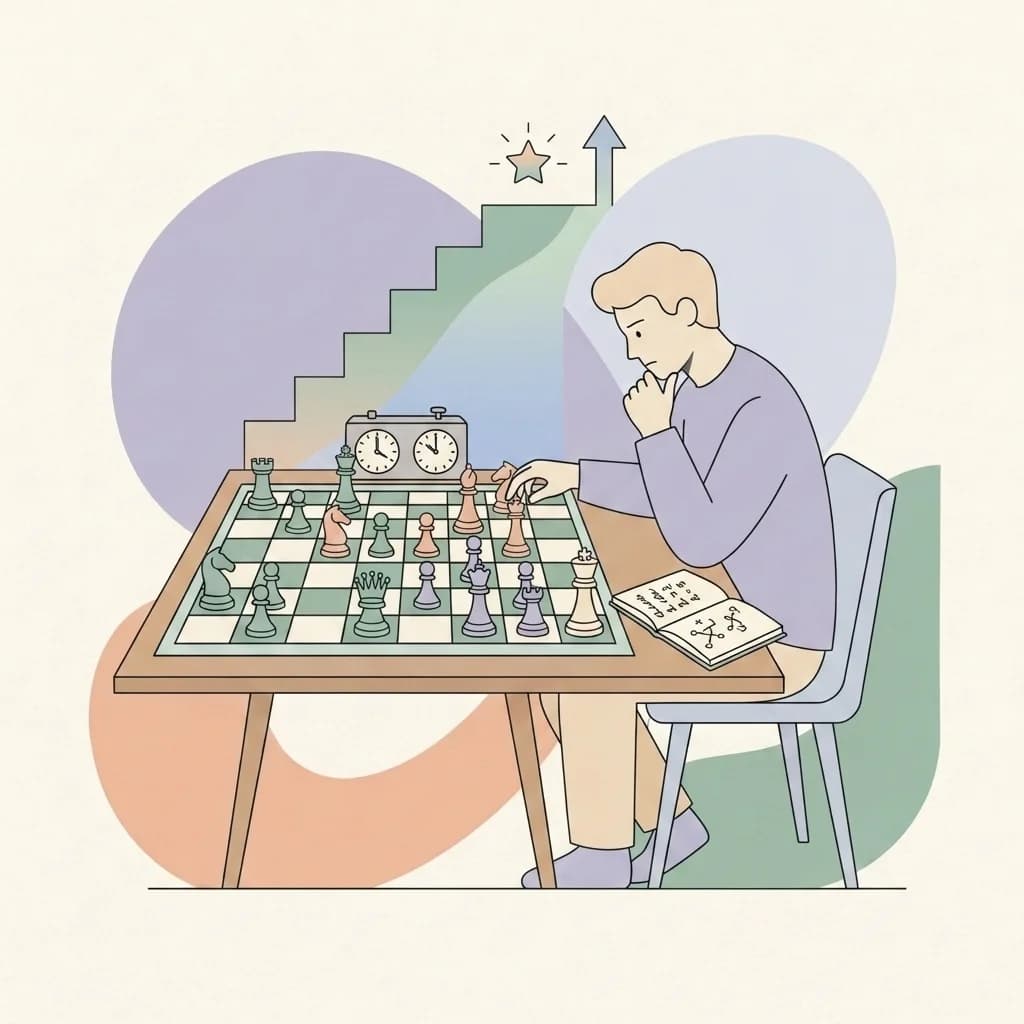
If I had to sum up what I observe after hundreds of students, it would be this: an average framework at any age beats untapped talent at any age. A player with a clear method, a stable rhythm, and a closed analysis loop improves almost mechanically. A player without a framework plateaus, regardless of when they started.
A good framework holds three elements: a rhythm you can sustain long-term, one priority at a time, and a verification that the work produces an effect on your actual games. Without those three, you fill time without closing the loop. With those three, every week adds something durable to your game.
That's why age is the wrong variable to track. What matters is your ability to install the framework and stick to it. A ten-year-old in a serious club with a regular coach has it. A disciplined adult who reviews games every week has it too. A teen grinding blitz without ever analyzing a single game doesn't have it, and plateaus despite the apparent age advantage.
The work order that fits every age
When a student starts, whatever their age, I give the same priority order. First, the rules and piece values, until they're automatic. Then simple tactical motifs: fork, pin, double attack. Then basic endgames: king and queen vs king, opposition in pawn endings. And only at the end, a little opening work, always understood rather than memorized.
This order works for a child, for a teen, for an adult. What changes is rhythm and vocabulary, not the topic hierarchy. A beginner who wants to improve needs to see the board, sense threats, and know how to finish a winning position. Openings come after, once those foundations are in place.
The trap to avoid, especially for adults, is starting with opening theory. You memorize fifteen moves of a line, your opponent plays something different at move sixteen, and you land in a position you don't understand. Weeks lost without gaining any practical strength.
For a child learning the moves at home, start with five small chess games for parents and children. Each game introduces one rule before you try a full board.
When a coach actually changes the trajectory
A coach isn't required to start chess. You can learn on your own with books and online platforms, especially as a disciplined adult. But a coach massively shortens the gap between "something feels off" and "I know exactly what to fix".
A coach's job isn't to explain the whole game. It's to look at your games, make the right diagnosis, pick the priority that will actually move your level in the next six weeks, and verify the work produces a measurable effect. That's especially valuable for a teen who scatters, an adult short on time, and a parent who wants to support a gifted child without burning them out.
If you're wondering whether it's the right moment, check do I need a chess coach?. You'll see the specific situations where coaching produces real ROI. If you eventually plan to play rated tournaments, the official rules and rating system live at FIDE.
What to remember
There is no ideal age to start chess. There are frameworks suited to each age, and the factor that actually makes the difference isn't when you learn the rules but the quality of the work you install afterward.
If you start as a child, bet on enjoyment and consistency. As a teen, channel the motivation and resist the scatter. As an adult, accept the apparent slowness and work with precision. In all three cases, the real question isn't "am I too late?". It's "do I have a framework I can hold for six months?".
Key takeaways
- Age sets familiarity, not your ceiling. Framework quality decides how far you go.
- Children need enjoyment and guidance, teens need focus against scatter, adults need precision against volume.
- The work order is the same at every age: rules, tactics, endgames, then openings.
- A coach is optional, but the right diagnosis at the right time is the fastest shortcut.
If the answer is yes, you can start today. To build that framework, begin with how to improve at chess efficiently. If you want help installing it from day one, JD Chess coaching is designed exactly for that.