
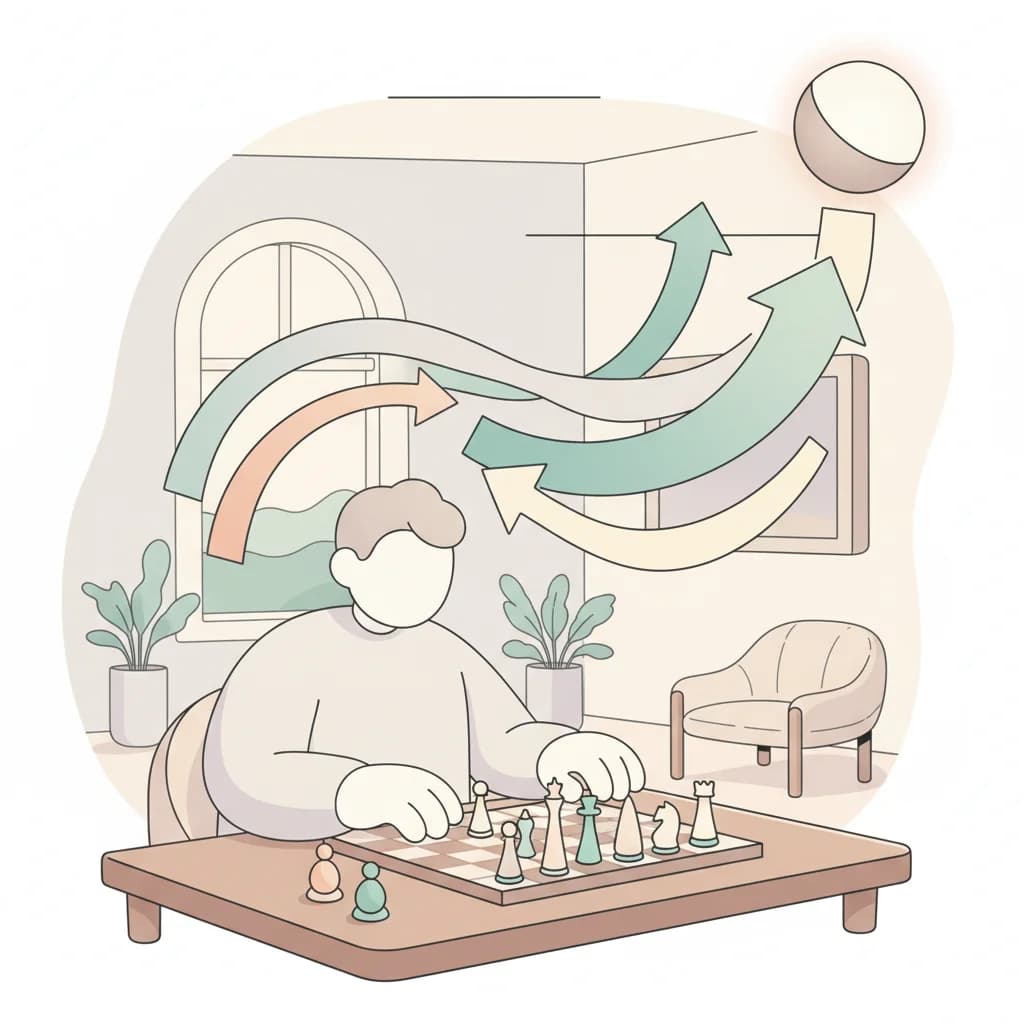
Improving at chess efficiently means turning every hour into real feedback. The players who progress fastest are not the ones who study the most. They are the ones who run a cleaner loop: play, review, diagnose, train, and test again.
Which format grows your game fastest?
If your current routine feels busy but not productive, the issue is rarely effort. It is structure. A bit of opening work, a few tactics, some videos, and too much blitz can feel like training, but it often leaves you with scattered habits instead of steady progress. The useful question is not "how much can I cram in?" but "what kind of work will actually change my next game?". A good method is simple to describe: clear, repeatable, measurable. If your plan is vague, overloaded, or impossible to sustain, it will break, and you will keep mistaking activity for progress.
Start from the games you already played
Your own games are the best source of improvement data because they show where your understanding actually breaks under pressure. They reveal which positions you misread, which plans you fail to recognize in time, when you drift without a real decision, where your calculation stops too early, and which endgames you still do not handle. That is why game review sits at the center of any serious improvement plan. Skip it, and you study in the dark.
The goal is not to list every mistake. It is to pull out two or three sharp priorities that will shape the next few weeks. Three serious losses reviewed honestly are usually enough to surface a clear pattern. If you want a structured method for this step, read how to analyze your games and use it as your baseline.
Review before the engine
A lot of players sabotage their analysis by switching the engine on too early. That gives answers before you have asked the right questions. You see the best move, but you still do not understand what you believed during the game, which candidates you considered, or why you chose what you chose.
Before the engine, mark the critical moments and write one sentence on what happened in your own words. Where did the position change? What was I trying to do? What did I miss? What would have been the better practical decision? Then the engine becomes what it should be: a way to verify and sharpen your diagnosis, not to replace it. That is the gap between scrolling through evaluations and actually analyzing.
Classify the mistake, not just the move
Two games can both end with a blunder and need completely different training fixes. One player blunders because their calculation is too shallow. Another misses a strategic idea. A third collapses in time trouble from a winning position. If you treat all three as the same problem, your training becomes inefficient.
Ask the question that matters when you review: was this mainly a tactical miss, a calculation error, or a positional misunderstanding? Did I choose the wrong plan, or fail to execute a good one? Was the issue technical, practical, or clock-related? Has this mistake shown up before in a different dress? The answer tells you where the next block of work belongs, which is far more useful than picking a topic because it sounds exciting. If your blunders survive months of puzzle rush, the fix is calculation discipline, not more puzzles.
Train one weakness at a time
Efficiency comes from narrowing focus. Most amateurs slow themselves down by trying to improve openings, tactics, endgames, strategy, and time management in the same week, with no real priority. The result is plenty of activity and almost no transfer to the board.
Pick one main theme for the next cycle. A cycle usually runs one to three weeks depending on how often you play. If you still miss simple tactics, train clean calculation with candidate moves verified, not rapid puzzle grinding. If your middlegames collapse, work on pawn structures, typical plans, and annotated games. If you lose equal endgames, train technique and simplification decisions. If you come out of the opening in bad shape, narrow the repertoire and understand the structures that follow. You do not need the perfect plan. You need a plan narrow enough that you can tell whether it is working.
Keep openings practical
Opening study is useful, but it is the easiest place to waste time. You do not need a huge repertoire to improve. You need openings that lead you to playable middlegames you understand. In practice, that means learning the ideas before the details, studying only the lines that appear in your games, knowing the pawn structures and plans that follow, and cutting variations whose complexity outruns your current level.
If you spend most of your study time memorizing details that never appear on the board, your work is too theoretical for your actual needs. A smaller repertoire you truly own will always beat an ambitious repertoire you half-learned. If this is your main leak, how to study chess openings without overloading and how to choose the right chess opening for your level are the right next reads.
Build real calculation habits
Many players say they "miss tactics" when the real issue is the quality of their thinking under pressure. Progress here comes from a stable decision process: spot the forcing moves, calculate the opponent’s best reply, compare candidates before choosing, then check that the resulting position is still playable.
This discipline matters even when there is no immediate tactic. It upgrades your decisions, not just your puzzle score. Short, regular calculation work beats the occasional marathon session that has no link to your real games. If this is one of your bottlenecks, how to stop studying chess randomly will help you build the habit week after week instead of in isolated bursts.
Keep the routine small enough to repeat
The best plan is the one you can sustain. A realistic week for most improving players looks like this:
- two or three serious games
- one thorough review of the most informative one
- one targeted study block on the cycle’s priority
- a short calculation or endgame drill
- a two-line written recap at the end
That is enough to create momentum if you keep doing it. A perfect plan that dies in two weeks is worse than a modest plan that survives six months. For a fuller weekly template you can copy directly, chess training routine puts numbers on each block. Clock management fits in here too: plenty of players train well and still lose from time pressure, burning minutes on routine moves and rushing the ones that matter. During review, check whether you enter time trouble from stable positions, whether you speed up the moment tactics appear, or whether your calculation quality drops sharply under the clock. If that sounds familiar, how strong players manage the clock is your next stop. And if you want to see where this efficiency frame keeps paying off as the level climbs, how to reach 2000 Elo in chess sets out the four technical skills that decide the upper plateau.
The habits that kill efficiency
The mistakes that wreck improvement are rarely mysterious. Studying without ever reviewing your own games. Changing openings every three weeks. Grinding puzzles without fixing thinking habits. Using the engine as a shortcut instead of a tool. Training five themes at once. Relying on blitz to create progress your study routine has not earned.
If any of those sounds familiar, the problem is not a lack of motivation. It is that your training loop leaks. Progress returns as soon as the loop closes: play, review, diagnose, train, retest.
When coaching speeds it up
A coach is not useful because they can do the work for you. They become useful when you want to cut the guesswork. The effort is already there, but the direction is not sharp enough, and week after week passes without real clarity.
In that case, the return is specific: identifying your actual bottleneck faster, saving you months on the wrong material, connecting theory to what truly happens in your games, and keeping the standard high when your motivation wobbles. If you are on the fence, do I need a chess coach? gives you the decision filter. And if you want a structured path with diagnosis, plan, and follow-up, JD Chess coaching is built exactly for that kind of player.
What to remember
Fast, lasting progress rarely comes from a complicated method. It comes from a few principles applied honestly. Start from your games, not from an abstract program. Pick few priorities at a time. Keep a routine you can repeat. Check regularly whether your work is actually changing your play.
Hold that rule (less scatter, more diagnosis, more useful repetition) and your study stops feeling random. It starts producing visible change on the board. That is what improving at chess efficiently really looks like.