
You know the rules. You can castle, you know how the knight moves, you understand check and checkmate. You sit down to play, push a pawn, develop something, and twenty moves later you are down a rook with no idea where it went. You lose. You play another game. Same result. You start to wonder if you are just bad at chess.
What kind of player are you really?
You are not bad at chess. You have no plan. That is the entire problem at the beginner level, and it is the only one that matters until you fix it. Beginners do not lose because they missed deep tactics. They lose because every move is improvised, with no idea what the position is asking for. Strategy for beginners is not about studying grandmaster games. It is about installing four or five simple principles you actually apply on every single move.
The fix is not learning more. It is doing less, but doing it consistently. Pick a small number of rules, apply them every move, and your results jump before you have studied a single opening line. This is what the beginner lessons on Lichess try to install from move one, and it is what a serious coaching path keeps reinforcing for the first two hundred rated games. If you are wondering whether you are even at the right starting point, when should you start chess is a useful detour. And if you want those principles installed with feedback on your own games, online chess coaching for beginners is built for that.
Principle 1: develop your pieces before you attack anything
The single most common beginner mistake is launching an attack with two pieces while four others are still on their starting squares. You move your queen out on move three, chase a pawn, lose three tempi, and now your opponent has all their pieces developed while your queen runs for its life. You are not attacking. You are losing time.
The rule is mechanical. In the opening, every move should either develop a new piece, control a central square, or prepare castling. If a move does not do one of those three things, it is probably wrong. A knight on f3, a bishop on c4, castling short, then a knight on c3 and a bishop on f4 or g5. That is five productive moves. You have not attacked anything, and you are already winning the game against most players under 1000.
The temptation is to do something flashy. Resist it. A boring developed position beats a brilliant half-built one every time. The structured beginner courses on Chess.com hammer this principle for a reason: it is the difference between losing in twenty moves and reaching a real middlegame.
Principle 2: control the center, even when nothing is happening there
The center is e4, d4, e5, d5. Whoever controls those squares controls the whole board, because pieces in the center reach further. A knight on e5 attacks eight squares. A knight on a3 attacks four, half of them off the board.
Beginners often flank-attack with rook pawns and wing knights, thinking they are "developing on the side". They are not. They are giving the center to the opponent for free, and a few moves later the position collapses inward because every central pawn break favors the side with central control.
The instruction is simple. Put a pawn on e4 or d4. Aim your bishops at the center. Put knights on f3 and c3 where they support central squares. Once your pieces all point inward, your position has gravity. Your opponent has to react to you. That is when chess starts feeling like something you are doing to them, instead of something happening to you.
Principle 3: castle early, and respect king safety like it pays your rent
Your king is the only piece that, if it dies, ends the game. Every other principle bends to that one. Castle by move eight or nine in almost every game. If you have not castled by move twelve, something has already gone wrong.
The reason beginners get crushed in twenty moves is almost always king safety. The king sits in the center, lines open, an enemy queen and bishop find a diagonal, and it is over. You did not lose because your opponent was a tactical genius. You lost because you forgot your king was a piece too. The Saint Louis Chess Club's beginner videos on the king show the patterns of how exposed kings die. Once you see the pattern three or four times you stop letting it happen.
Castling is not just defensive. A castled king lets your rook come to the center, which is the move that usually starts the real middlegame. You do not castle to be safe. You castle to be done with the opening.
When not to castle right away
Sometimes castling into your opponent's attack is worse than leaving the king in the center. If your opponent has pushed pawns and aimed pieces at the kingside, castling kingside walks straight into the fire. Castle queenside, or delay castling and finish development. The principle is "get the king safe", not "always castle short on move eight". The official FIDE Laws of Chess cover exactly when castling is legal, worth a quick read once because beginners still try to castle through check.
Principle 4: never trade a good piece for a bad one
This principle separates beginners who plateau at 600 from beginners who climb to 1000 in a few months. Every trade changes the balance of the remaining pieces. Trade your strong, active bishop for your opponent's passive, blocked-in bishop, and you have just done them a favor. You are equal in material and worse in everything else.
The question before any trade is short, and you ask it every single time. Which side ends up with the better remaining piece? If the answer is you, take the trade. If the answer is your opponent, refuse it, even if the trade is "natural". The most expensive beginner habit is trading on autopilot because the material counter stays even.
Concrete case. Your knight is on a strong central square, attacking three of your opponent's pieces. Their knight is stuck on the back rank doing nothing. They offer the trade. You accept because "knight for knight is even". You just traded your best piece for their worst one. The position is now lost. If you want to drill this kind of judgment, Chesstempo's tactical training for beginners forces you to evaluate which pieces are actually doing real work.
Principle 5: find your worst piece and improve it
When the position is quiet, when nothing is being attacked, when you have no idea what to do, do not push a random pawn. Look at your pieces, find the one doing the least work, and improve it. That is the entire instruction. Beginners freeze in quiet positions because they think strategy is supposed to feel clever. It is not. Most of strategy at the beginner level is "your rook is on a1 doing nothing, put it on d1 where it sees the center".
The worst piece is almost always obvious once you ask. A bishop locked behind its own pawns. A knight on the rim. A rook on a closed file. A queen still on its starting square in the middlegame. Each is a free improvement waiting for you to take it.
This principle also tells you what to do when you have an advantage. You do not need a tactical knockout. Keep improving your pieces while your opponent does nothing. Their position cracks under the pressure of you having better pieces on better squares, and a tactic appears that you do not have to invent. It shows up because the position was built correctly. That is exactly the logic strategic imbalances in chess extends once these basics are stable.
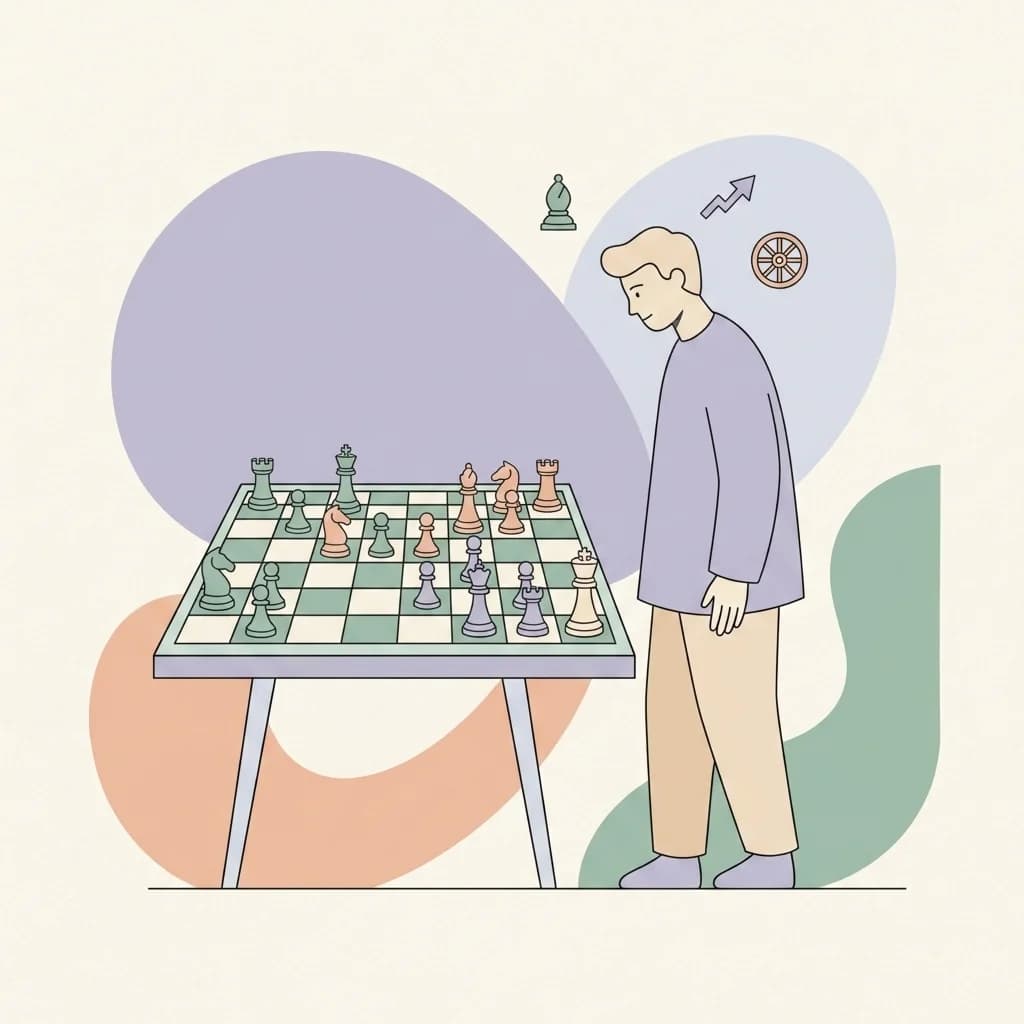
What beginners do vs what works
Here is the honest comparison, the one that hurts a little to read.
| What beginners do | What works |
|---|---|
| Move the queen out on move three to attack a pawn | Develop knights and bishops first, queen last |
| Push wing pawns to "make space" | Push central pawns to e4/d4 to fight for the center |
| Delay castling because nothing is threatening the king | Castle by move eight, every game |
| Trade pieces because the material counter stays even | Trade only when your remaining piece is better than theirs |
| Push random pawns when the position is quiet | Find the worst piece and improve it |
| Chase opponent threats reactively | Have a plan, check threats inside your plan |
| Study openings to memorize twenty moves | Apply five principles to your first twenty moves |
If you recognize three or more rows on the left as describing your last game, you do not have a knowledge problem. You have an application problem. The principles on the right are not advanced. They are the ones you keep forgetting to apply when the clock starts ticking.
The fix is a short check you run before every move. Five questions, in order, thirty seconds total:
- What did my opponent just threaten?
- What are all my pieces on, and is any of them hanging?
- What does my plan want me to do here?
- Which of my candidate moves matches the plan and does not drop material?
- After my move, what is my opponent's best reply?
You will catch eighty percent of your own blunders before they happen. You will also notice that you actually have a plan, because question three forces you to articulate one. If you cannot answer question three, your real problem is not the blunder. It is that you have been improvising for fifteen moves and the blunder was inevitable. Building this routine into a reflex is exactly what a structured chess training routine is for.
The mistakes that keep beginners stuck
There are four mistakes I see in every beginner I review, and they are the reason most players plateau at 600 to 800 Elo for years.
The first is studying instead of playing. You watch four hours of YouTube and play one game. Reverse that ratio. Play three games, study one. You learn chess by losing chess and figuring out why, not by watching it.
The second is playing too fast. Five-minute blitz is fine in moderation, but if it is your only format, you are training yourself to never think. Play fifteen or thirty-minute games. The thirty-second pre-move routine is impossible in blitz, and it is exactly the routine you need to build right now.
The third is not reviewing your losses. After every loss, look at three things: where did your plan break, where did you drop material, and what was the first move where you knew you were lost. Three minutes per game builds the pattern recognition that turns into intuition over a few hundred games.
The fourth is changing principles every week, and it ties into the worst beginner habit of all: obsessing over openings. You do not need to study openings yet. For white, play 1.e4 or 1.d4, develop knights before bishops, castle by move eight, aim everything at the center. For black, respond with 1...e5 or 1...c5 against 1.e4, and 1...d5 or 1...Nf6 against 1.d4. That is enough to reach a playable middlegame against any opponent under 1200. Memorizing twenty moves of the Najdorf is wasted time at this level. Spend it on tactics and game review instead. The +500 Elo in 10 weeks method walks through the priority order if you want a full cycle.
Key takeaways
- Beginners lose because they have no plan, not because they lack theory.
- Five principles fix most of it: develop before attacking, control the center, castle early, never trade a good piece for a bad one, improve your worst piece.
- Run a thirty-second pre-move check every move: threats, hanging pieces, plan, candidate moves, opponent reply.
- You do not need openings yet. You need to apply principles in the positions you reach.
- Play more than you study, review every loss in three minutes, and do not switch your principles every week.
To practise the piece-safety part of the routine on a board, work through six exercises for avoiding hanging pieces. They isolate attacks, defenders and the lines that open when a piece moves.
The real next step
If you took one thing from this article, make it this: pick the five principles, write them on a sticky note next to your screen, and apply them in your next ten games before you read anything else. You will lose fewer games on move fifteen. You will reach middlegames where you actually have a plan. Your rating will move within a month, not because you got smarter, but because you stopped playing on reflex.
If you want this framework applied to your actual games, with someone who reviews them with you and tells you which principle you keep dropping, look at the JD Chess coaching offers or book a first call. One game review is usually enough to see the pattern you keep repeating, and one corrected pattern is often the difference between losing every other game and starting to win consistently.