
Most players I coach fall into the same two traps when they review their games. They open the engine immediately and confuse correction with understanding. Or they take notes everywhere, look at twenty positions, and close the window without knowing what to train next. A checklist cuts both of those drifts.
Which format grows your game fastest?
The point is not to give you more information ; it is to force you to extract the right one, in the same order, every time. A short checklist you actually apply beats a perfect method you drop after three days. What follows is the framework I use with students to move from "I played badly" to "here is exactly what I train this week."
Why a checklist beats free-form review
After a game, your brain jumps to what is visible: the big blunder, the move where the evaluation collapses, the moment you felt the game slip. The problem is that the useful mistake is almost never there. The real turning point happened earlier, in a quiet move you played without really thinking.
A checklist forces you to slow down and inspect the game in a fixed order. You stop asking "where did I lose" and start asking when the position stopped being comfortable, what kind of mistake happened, and what you will do about it. That fixed order, applied after every serious game, is what turns an emotional review into a diagnosis. For the broader frame, start with how to analyze your games ; this article is the operational version.
Step 1: replay the game without the engine
Until you have replayed the game alone, you are not analyzing. You are watching an automatic correction, and you are throwing away the raw material of progress: your own reasoning. This first box is non-negotiable.
When you replay, you do not comment on everything. You only look for shifts in your own head: where you hesitated for too long, where you changed plan for no clear reason, where you played a move on autopilot. Two or three markers are enough. Skip this step and the rest of the review stays shallow, because the engine has already whispered the answer.
Step 2: find the real turning point
The real turning point is almost never the last bad move. Most often the game tilted well before that, in a moment that looked ordinary. That is exactly what you are hunting for.
Ask yourself: from which move did I start playing without a real idea? That is where the quality of your decisions dropped, and that is where you learn something. A 1500 student recently thought he had lost on a blunder at move 32 ; in reality he let his opponent activate the pieces at move 18, and the rest was just the consequence. Without this step, you keep reducing the review to the last dramatic move and you miss the pattern. How to find the turning point in a chess game goes deeper on the technique.
Step 3: label the mistake in one category
This is the most powerful box in the checklist. "I played badly" gives you nothing to work with. A clean label gives you a training axis. Keep a simple grid and ask the real question : which type of mistake best explains this game?
The useful categories fit into seven families. Tactical (missed motif, missed forcing move), calculation (line stopped too early or misjudged), plan (no clear idea in a quiet position), opening (came out of the opening misjudging the position), endgame (conversion or technical defense failed), time (clock mismanaged), and mental (rushed, afraid, frustrated). Pick one, the one that dominates. Not three. The discipline is to name the main problem instead of drowning it in a tickbox list, and that discipline is what makes the label actually useful for deciding what you will train.
Step 4: the engine verifies, it does not think
The engine comes in here, not before. Its job is not to tell you what to think ; it is to test whether your diagnosis holds. You open it with a hypothesis and see whether it confirms or contradicts you.
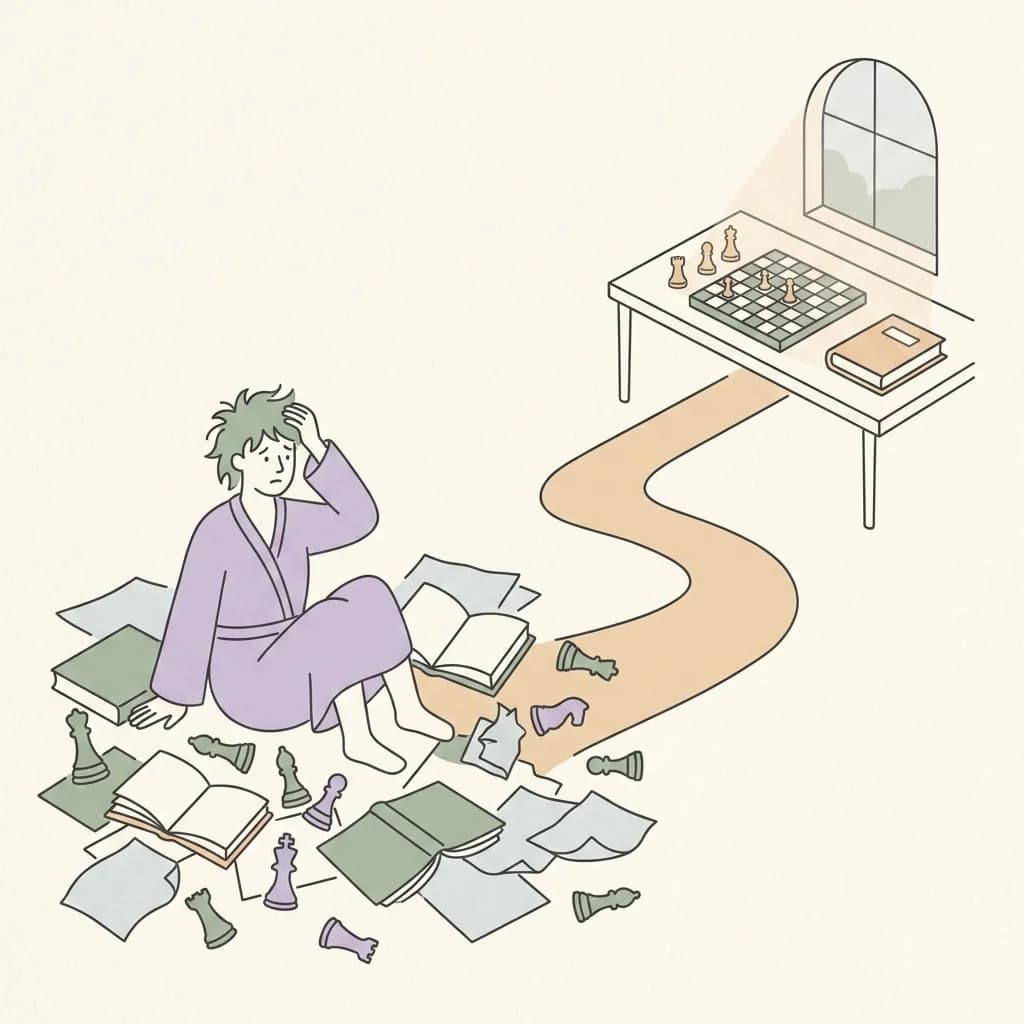
Focus on the two or three critical positions you marked, nothing else. You want to know whether you missed a simple tactic, whether your evaluation was off, whether the problem came from the move itself or from an earlier idea. Three positions examined seriously beat a whole game scrolled through. For the full protocol, see how to use a chess engine after a game without becoming dependent on it.
Step 5: leave with one training action
If your review ends at "I understood my mistake," it is useless. The bridge between analysis and next training block has to be explicit, or the lesson evaporates in three days.
A good checklist ends with one action, not three. Concrete examples: you missed several forcing moves, so fifteen minutes of targeted calculation every day for a week. You had no plan in a closed structure, so two model games in that structure. You botched a winning pawn endgame, so three elementary endgames close to the theme. One game, one diagnosis, one action. That direct link is what stops the review from becoming sterile intellectual activity.
The checklist to reuse after every game
Here is the short version to paste into your notes:
- Replay the game without the engine
- Mark two or three critical moments
- Identify the real turning point
- Label the mistake in one category
- Check the engine on the key positions
- Choose one training action for the week
You can even boil it down to a sentence: one game, one diagnosis, one action. As long as that chain holds, every serious game feeds your progress. The moment it breaks, you fall back into decorative review.
When the checklist is not enough
The checklist raises the quality of your reviews, but it does not solve everything. If you have been labeling the same mistake for six weeks without anything moving, if you understand the game afterwards but never during, if you cannot rank your priorities anymore, the checklist is no longer the issue. The issue is the absence of a broader framework, and that is where an outside eye saves months. If you want help structuring the work, take a look at JD Chess coaching. Otherwise, keep applying the grid, seriously, after every serious game. The rest follows.