
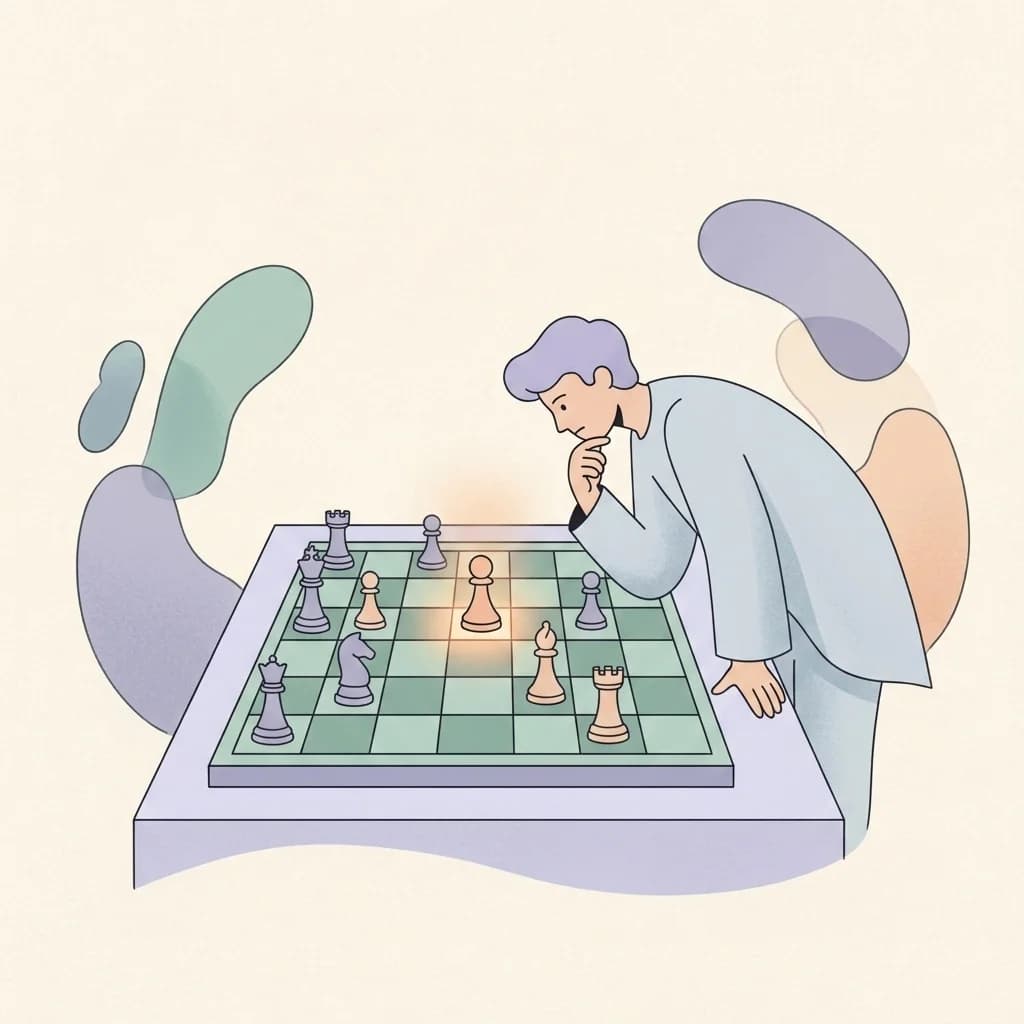
Most students can show me the move that lost the piece. Very few can tell me why that move was nearly unavoidable by the time it appeared.
How do you actually train chess?
That gap is what separates a review that kills ten minutes from a review that reshapes your training week. Stay on the final blunder and you fix a symptom; the same pattern will come back in a different game, dressed up differently. Find the real turning point and you start seeing the machinery that made the mistake probable in the first place.
The turning point is rarely the flashiest moment in the game. It is the first point where your position became meaningfully harder to play, often before anything visible went wrong. Learning to name that moment changes how you analyze, and it changes how you train. For the wider review framework, start with how to analyze your games.
Start with comfort, not with the blunder
The first question is not "where did I blunder?". The better one is "when did I stop being comfortable?".
Your brain wants a clean anchor, so it grabs the last obvious mistake. That is reassuring because it is visible, but it is almost always downstream of a slower decay that started several moves earlier. Replay the game once without the engine, and at every move ask yourself whether you still like your position in human terms: are your pieces doing something, is your plan still coherent, are you creating problems for the opponent.
The first move where the answer gets fuzzy is your main candidate for the turning point. Not the blunder itself, but the move that made the blunder likely.
Separate the trigger from the cause
The final mistake is the trigger. The fork, the pin, the missed mate, the endgame you could not convert: you see it because it hurts. But the trigger is almost never the cause.
The cause sits earlier. Maybe you gave up the initiative with a cautious move when the position asked for energy. Maybe you traded your good bishop for a passive piece because the trade looked natural. Maybe you accepted a structure you did not know how to play. Each of these decisions feels reasonable at the time, but each one quietly narrows your options. By the time the tactic shows up, it is just collecting what earlier choices set up.
This distinction is subtle but it changes everything. Fix only the trigger and you train a tactic. Fix the cause and you close a real hole in your game.
The four shapes of a real turning point
When I debrief a game with a student, the moment almost always falls into one of four families.
A strategic turn means you accepted a structure, a weak square, or a trade that changed the nature of the position for good. A dynamic turn means you lost the thread of the initiative, usually by playing a safe move in a position that demanded pressure. A psychological turn means your mental posture shifted mid-game; you wanted to simplify because you were afraid, or you rushed to patch an imprecision. A technical turn means you picked the wrong transition, traded a pair of rooks too early, or drifted from a potential attack into a passive endgame.
None of these need to be dramatic to be decisive. A strategic turn often leaves the game "playable" for a long time, but the trajectory is already set. A psychological turn can happen on an objectively correct move; what shifted was not the position but your relationship to it. Naming the family already tells you where the real problem lives.
Test the moment from both sides
Once you have a candidate, check it from White's and Black's perspective, even if you only played one side.
What were you trying to achieve right there? What did your opponent want? Which side ends up with better activity, a better structure, the safer king? If your position was already less pleasant to play before the tactic hit, the turning point is earlier. If everything was fine until one forcing sequence, then the turning point is the move that allowed that sequence.
This forces you to evaluate the position instead of just grading your move. A lot of players think they missed a tactic when the deeper issue was that they had already accepted an uncomfortable structure several moves earlier. For the emotional side of this work, how to review a lost chess game without losing confidence gives you the frame that makes honest review sustainable.
Common false turning points
Some moments pull your attention without being the real cause. Be careful with each of these.
- the last move before a blunder
- the first move the engine dislikes
- a trade you remember vividly
- the move where your clock got uncomfortable
- the final collapse after a long bad position
These can matter, but they are not automatically decisive. A move that looks red on the engine is often the downstream of a position that was already painful. A trade you remember is often the one that stung emotionally, not the one that actually changed the game.
Strong analysis is usually boring in the right way. It names the quiet decision that moved the trajectory, even when that decision looked harmless over the board. Do not push drama into the review; look for the sober answer.
Use the engine at the right moment
The engine is useful, but not first. Turn it on before you have built your own hypothesis and you will anchor on the first red move and skip the human work that actually improves you.
Put your hypothesis down, then ask the engine precise questions. Does the moment I flagged really change the evaluation or just the practical difficulty? Which alternative kept the most options open? Was the final mistake already hard to avoid after the suspected turning point? Very often the engine confirms what your human read already suggested: the blunder exists, but the position became worse several moves earlier. That nuance is what decides which training axis the game feeds into.
To structure that dialogue with the machine, how to use a chess engine after a game without becoming dependent on it is the right companion piece.
Turn the moment into a training category
Finding the move is not enough. You have to be able to label it, because the label is what tells you what to train next.
A strategic turn sends you toward structures, good and bad pieces, trade criteria. A dynamic turn sends you toward piece activity, prophylactic moves, plans in open or semi-open positions. A psychological turn sends you toward clock management and decision discipline. A technical turn sends you toward model endgames and simplification criteria.
If you cannot categorize the turning point, the lesson stays vague, and vague lessons do not change future games. That is also why at JD Chess the review never stops at "I lost here"; it always produces one training priority for the following week.
A simple method to find the turn
If you want a short protocol, use this after every serious game.
- replay the game once without the engine
- mark the first move where comfort disappears
- name the family: strategic, dynamic, psychological, technical
- compare two or three credible alternatives
- check with the engine and close with one sentence
The closing sentence forces you out of the fog: "the game really turned when I traded my good bishop", or "when I tried to simplify a position that still needed energy". If you cannot write that sentence, you have not found the turning point yet; you have only approached it.
When outside eyes change the picture
The problem is rarely that you do not review your games. The problem is usually that you review the wrong moments. Many players correctly identify the final blunder but systematically miss the decision that set it up, because that read takes a level of position evaluation they are still building.
That is exactly where a coach compresses time. Not to play the moves for you, but to name the real problem and turn every lost game into a clear axis of work. If that is what you are missing, look at JD Chess coaching.
What to remember
The real turning point is almost never the blunder. It is the earlier decision that made the rest of the game harder, usually quiet, usually reasonable on the surface, but heavy in its consequences.
Learn to find it, name it, classify it, and your review stops being a post-mortem and becomes a tool for progress. Less drama, more clarity, and every lost game becomes a real lesson.