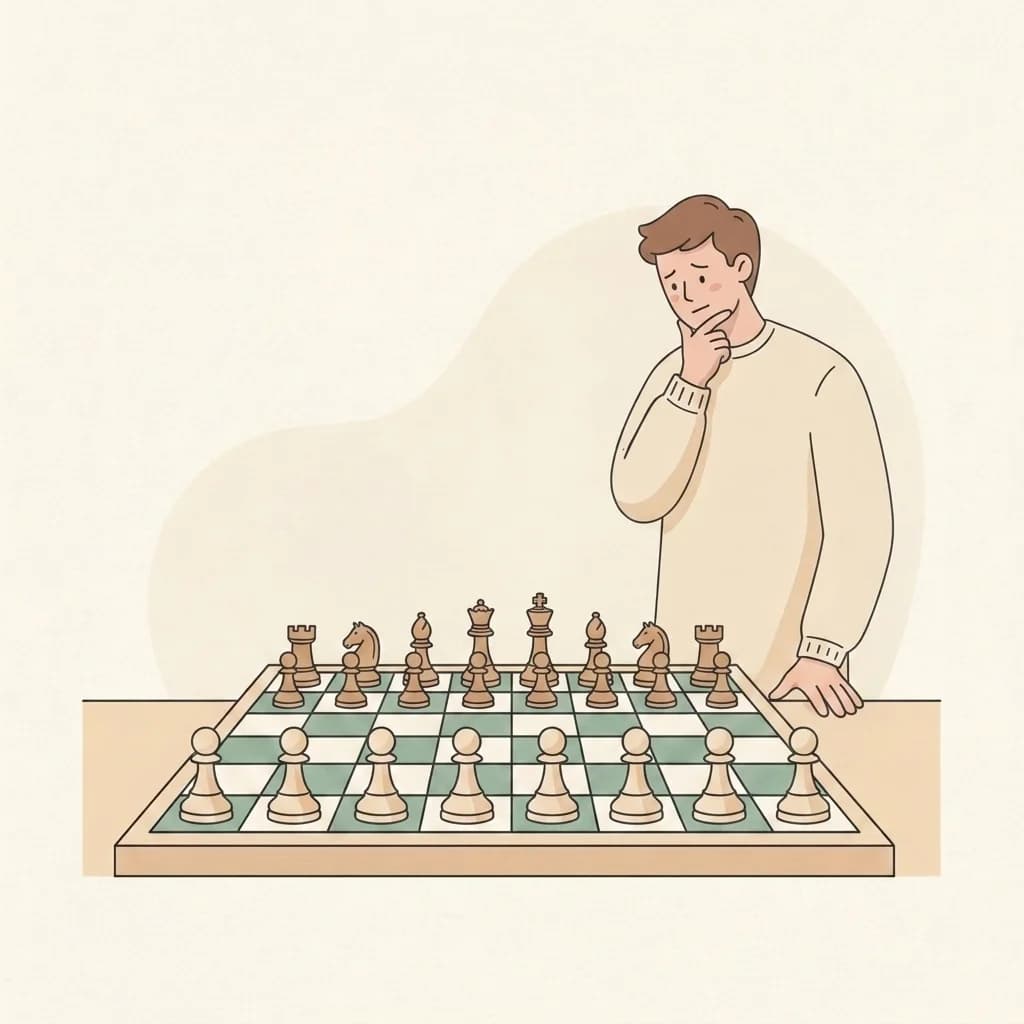

Most chess gifts are bought for the person who loves the game, not for the player they are trying to become. That is how people end up with a decorative glass set nobody plays on, or a 500-page manual with a bookmark stuck on page 40. Neither is a bad present. They just do not change much at the board.
How do you actually train chess?
The best gift for a chess player matches their level: a plain, regulation-proportion set and one readable book for a beginner, a digital clock and a well-chosen endgame or structure book for a club player, and the book or coach they have chosen themselves for a competitor. Before you buy, ask one question: does this person play mostly for fun, at a club, or in rated tournaments? The answer changes almost everything below.
I coach players from their first games up to around 1800 Elo, and this guide is written from what my students actually use. There are no affiliate links and no shop prices here. Where I quote equipment standards or name a book, the source and the edition are listed at the end.
Quick answer: what to give at each level
| Level | Most useful gift | Usually wasted |
|---|---|---|
| Beginner: knows the moves, plays casually | A plain Staunton set on a board with 5–6 cm squares, and one friendly book | Themed or ornamental sets, advanced opening books |
| Club player: plays every week, maybe a first rating | A digital clock with increment, one endgame or pawn-structure book, a few coaching hours | Yet another opening repertoire book |
| Competitor: plays rated tournaments regularly | The training book on their own list, travel gear, time with a coach who fits their level | Generic "improve fast" products |
"Usually wasted" does not mean "never welcome". It means the gift rarely changes how they play.
What every chess player needs, whatever the level
Anyone who wants to improve needs three things: a board they can read clearly, a way to play against a clock, and a way to look back at their own games. Everything else is optional.
The board and pieces matter more than most buyers expect. On a tiny travel set, or a set where the bishops and pawns look alike, beginners misread positions. FIDE's equipment regulations give useful reference figures, even for a set that will never leave the living room. According to the FIDE Handbook rules for chess equipment without electronic components, approved by the FIDE Council on 11 December 2025 and applied from 1 March 2026:
- pieces should be Staunton style, made of wood, plastic or a material that closely imitates them;
- the reference king height is 95 mm, with the other pieces scaled down (queen 85 mm, bishop 70 mm, knight 60 mm, rook 55 mm, pawn 50 mm), within a tolerance of ±10% as long as the order of heights is kept;
- the base of each piece should be between 40% and 50% of its height;
- each square should measure between 5 and 6 cm, and four pawns must fit comfortably on a single square;
- finishes should be matte rather than shiny, and the contrast between light and dark squares must be recognisable by colour-blind players.
You do not need a tournament-certified set at home. But a set close to those proportions means the person practises on the same picture they will see at a club or a tournament. If a product description does not state the king height and the square size, choose another set.
Gifts for a beginner
Here, a beginner is someone who knows how the pieces move and plays casually, online or with family. It can be a child or an adult.
Equipment
Give one full-size, plain set rather than a beautiful but impractical one. Sets with fantasy or film characters are fun on a shelf, but they make it harder to recognise the shapes and patterns a beginner is learning. For a child, a roll-up board with plastic Staunton pieces is light and survives being dropped; just check that the squares are in the 5–6 cm range. A clock is not a priority yet.
Books
One book matched to the reader beats a shelf of them.
- For children: Chess for Children by Murray Chandler and Helen Milligan (Gambit Publications, 2004, ISBN 978-1-904600-06-0). Short and illustrated, it works well read together with a parent.
- For adults: Logical Chess: Move by Move by Irving Chernev, in the Batsford algebraic edition (ISBN 978-0-7134-8464-9). Every move of 33 complete games is explained in plain language, which shows how a whole game hangs together.
With any older classic, make sure you buy an algebraic-notation edition. The old descriptive notation, where a move reads like "P-K4", is a real obstacle for a newcomer.
Free tools
Lichess describes itself as free, with no ads, and open source. A beginner can play, solve puzzles and use the analysis board without a subscription. The real gift is your time: sit down together, create the account, and play a few games at a slow time control.
Coaching time
The first months decide whether someone keeps playing. A few hours with a coach at this stage are less about "getting better fast" than about forming habits that last: checking what the opponent threatens, looking at the whole board, and enjoying the game. If you are buying for a child, how to teach your child chess explains what a parent can do alongside lessons.
Gifts for a club player
A club player plays regularly, probably has an online rating, and may have played a first rated game or two. They usually own a set already.
Equipment
The most useful object at this level is a digital chess clock with increment, also called Fischer mode. Many events use an increment, and players who have only played online are often surprised by a physical clock the first time. FIDE's rules for chess equipment with electronic components, approved and applied on the same dates, give criteria you can check in a product description or manual:
- both displays readable at 3 metres in normal lighting, with a clearly visible flag signal;
- seconds displayed at least during the last 20 minutes of a time control;
- in increment mode, the increment added before the first move;
- a clear battery-level indicator.
Setting a control such as 90 minutes plus 30 seconds per move should take a minute, not an evening. A scorebook is a cheap, useful extra: recording games is a habit that pays off when it is time to review them.
Books
Club players usually own too many opening books. What tends to change their results is endgame technique and an understanding of pawn structures.
- Silman's Complete Endgame Course by Jeremy Silman (Siles Press, 2007, ISBN 978-1-890085-10-0). It is organised by rating level, so the reader studies what matters for their current strength and can stop there.
- Chess Structures: A Grandmaster Guide by Mauricio Flores Rios (Quality Chess, 2015, paperback ISBN 978-1-78483-000-7). It covers 28 common pawn structures and the plans that go with them, a good fit for someone who often says "I never know what to do after the opening".
Free tools
At this level, encourage a habit rather than another app. After each club game, the player enters it into a free analysis board and looks for the moment the game turned before switching the engine on.
Coaching time
This is the level where coaching usually gives the most visible return, because the player has enough games for a coach to find recurring mistakes. Ten hours spread over several weeks leave time to diagnose, assign work and check that it has been done. If they are planning their first event over the board, the first OTB tournament checklist is a free companion to whatever you give.
Gifts for a competitor
A competitor plays rated tournaments regularly. They often already have a coach and a training routine.
Equipment
They own a clock and a set. Practical gifts work better: a compact travel set for analysis between rounds, spare scorebooks, or a sturdy bag for board and clock. Before buying a clock, ask: many competitors prefer to train on the same model they meet in tournaments.
Books
At this level, do not choose the book on their behalf. Ask which title is on their list, or pick a demanding classic they are unlikely to own yet:
- Dvoretsky's Endgame Manual by Mark Dvoretsky, fifth edition (Russell Enterprises, 2020, ISBN 978-1-949859-18-8). The reference work on theoretical endgames: dense, and best suited to serious tournament players.
- Grandmaster Preparation: Calculation by Jacob Aagaard (Quality Chess, 2012, hardcover ISBN 978-1-907982-31-6). Hard exercises for players who already calculate well and want to go further.
Both are demanding. Given to a player below this level, they will probably stay on the shelf.
Free tools
Competitors know the tools already. Often the most useful thing you can give is quiet time: a weekend free of other obligations before an important tournament is a real present.
Coaching time
Be honest about fit. A competitor's coach should be clearly stronger in the areas they want to work on. I coach players up to around 1800. If the person you are buying for is rated well above that, a voucher with me is not the right gift: ask them which coach or training camp they would choose. How to choose a chess coach lists the criteria worth checking.
Giving coaching time as a gift
For someone between their first games and around 1800, coaching hours are the gift that adapts most easily to their level, because the work starts from their own games rather than from a generic programme.
The JD Chess gift voucher comes in two formats:
- Discovery Gift, $120: three hours of one-on-one online lessons, plus a free 30-minute discovery session to calibrate the level and set a direction. A good choice for a beginner or someone coming back to chess.
- Immersion Gift, $350: ten hours of one-on-one online lessons, plus the same free 30-minute discovery session. For a club player who wants to work regularly over several weeks.
You pay online and receive a personalised PDF voucher by email, with the recipient's name and your message, ready to print or forward. The recipient writes to JD with their gift code, and lessons are arranged subject to availability within the voucher's 12-month validity. If you would like to see how lessons work before choosing, the online chess lessons page explains the format.
FAQ
What is the best gift for a chess player?
The one that matches their level. For a beginner, a plain Staunton set with regulation proportions and one readable book. For a club player, a digital clock with increment, an endgame or pawn-structure book, or coaching hours. For a competitor, the book or coach they have chosen themselves.
What does every chess player need?
A clear, regulation-proportion set, a way to play with a clock, and a way to review their own games. A free platform such as Lichess covers the review side; a coach helps make that review useful.
What is a good gift for someone who loves chess but does not play seriously?
Then the gift can be about enjoyment rather than improvement: a handsome set they will actually play on, or a few lessons to rediscover the game. Ask whether they would like to play more before choosing a training book.
Is a coaching voucher delivered immediately?
For the JD Chess gift voucher, yes: the personalised PDF is sent automatically by email once the online payment is confirmed.
Sources
All sources were checked on 23 October 2026.
- FIDE Handbook, section C.02, Chess Equipment without Electronic Components, approved by the FIDE Council on 11 December 2025, applied from 1 March 2026. It replaced the previous "Standards of Chess Equipment", valid until 28 February 2026.
- FIDE Handbook, section C.02, Chess Equipment with Electronic Components, same approval and application dates.
- Lichess, About page.
- Book editions checked against Open Library ISBN records: Chess for Children, Logical Chess: Move by Move, Silman's Complete Endgame Course, Chess Structures, Dvoretsky's Endgame Manual, Grandmaster Preparation: Calculation.
FIDE figures are reference standards for competitions. Event organisers and national federations may apply their own equipment rules, so check the tournament announcement before travelling with your own set or clock.