
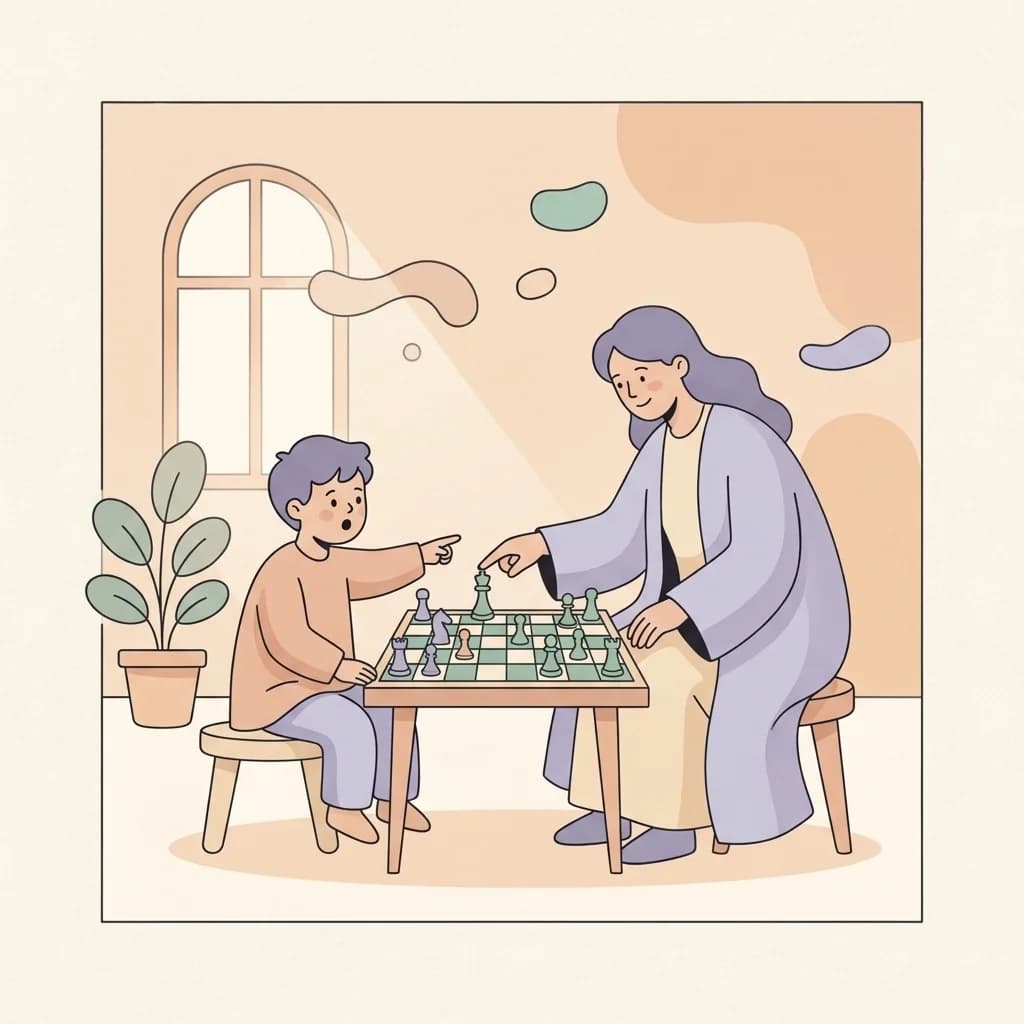
Teaching a child chess goes wrong when the first lesson feels like a test. You explain every piece, correct every move, then wonder why the board stays in the cupboard. A beginner does not need a lecture on strategy. They need a reason to touch the pieces again tomorrow.
How do you actually train chess?
Start with short games. Each one teaches one thing, ends quickly, and gives the child a clear way to win. Stop while they still want one more round. ChessKid's learning resources are useful inspiration for keeping early practice playful; these are original board activities for a normal chess set.
1. Piece parade: learn what each piece does
Set up an empty board. Put one white piece on d4. You are the caller and your child is the mover. This is a movement game: there are no captures, checks, or turns for another side.
- Name one piece: rook, bishop, queen, knight, king, or pawn.
- Your child moves it legally to any square they choose.
- They say the destination aloud: “The bishop goes to g7.”
- A legal move earns one point. For an illegal move, show the line or shape, then let them try again.
Reset the piece to d4 after each move. Use one piece for three turns, then switch. Do not make them memorize coordinates first. Let the names arrive through repetition. The knight is usually the fun moment: put it on d4 and ask which squares it can reach. A child who can see the L-shape has learned something real, even before they know why a knight matters in a game.
Keep the round to ten points.
2. Pawn race: make promotion concrete
Place one white pawn on a2 and one black pawn on h7. Remove every other piece. White moves upward toward rank 8; Black moves downward toward rank 1. White goes first.
Each player moves one pawn by the normal rule: one square forward, or two squares from its starting square if the path is clear. There are no captures in this first version. The first pawn to reach the last rank wins. Swap colours after each race: going first is an advantage.
When a pawn arrives, pause before resetting. Ask what it could become. Let the child choose a queen, rook, bishop, or knight, then put that piece on the promotion square. You do not need to explain underpromotion yet. The useful lesson is that a small piece can become a powerful one by reaching the other side.
Teach captures as a separate position. Put a white pawn on c4 and black pawns on b5 and d5. White chooses one diagonal capture. Remove the captured pawn, place the white pawn on that square, and reset. A pawn never captures straight ahead.
3. Knight treasure hunt: practise the L-shape
Put a white knight on b1. Place five coins or buttons on d2, c3, a3, b5, and d4. Those are the treasures. The child wins by landing on every treasure square with the knight.
They get one knight move at a time. After each move, remove the treasure from the square reached. Landing on an empty square costs nothing; they simply continue from there. Count how many moves the hunt takes, then see whether they can do it in fewer next time.
Do not give the route. If they ask for help, point to two squares in one direction and one square across, then let them choose. The knight moves unlike the rook and bishop. Repeating one unusual movement in a small game works better than correcting it during a full game.
4. Guard the treasure: place a defender
Put a white pawn on a2 and a black rook on a8. Leave the kings off the board. Ask your child to place a white rook on b2, b1, or h2, then say whether it defends the pawn on a2. This is a placement puzzle, not a full game.
Test the answer the same way each time: Black plays ...Rxa2. If the white rook can capture the black rook on a2 on its next move, the pawn was defended. From b2, the white rook can play Rxa2, so it is defended. From b1, it cannot reach a2 in one rook move, so it is not. From h2, it can play Rxa2, so it is defended.
Reset the three pieces and let the child choose again.
5. Checkmate in one: finish the job
Set up White king f6, White queen g6, and Black king h8. White to move. Ask your child to find a move that checks the king and leaves no legal escape.
The answer is Qg7#. The queen checks the king on h8. The white king protects g7, and the queen covers h7 and g8. Put the pieces back and let your child show every square Black cannot use.
Then use White king g6, White rook a1, and Black king h8. White plays Ra8#. The king on g6 covers h7, while the rook covers g8 and gives check along rank 8. Ask them to name the checked king, the attacking piece, and the escape squares. Checkmate is not just “check plus a symbol.” It means the king is attacked and cannot move, capture the attacker, or block the attack.
One puzzle is enough for a session. If the child misses it, move the queen or rook one square at a time and ask what changed. Let the board give the answer.
Turn the games into real chess slowly
After a few sessions, play a short real game with one rule: pause after every capture and ask, “What changed?” Do not restart whenever a piece is lost. Let the child see that a game can be messy and still be playable.
The first full games should be friendly and short. You can agree to stop after twenty moves, or when both players want a reset. Teach legal moves and basic checkmate before openings. A child who understands the pieces, protects a treasure, and enjoys finding a mate in one has the right foundation for the next step.
If you are unsure when to make chess more structured, when should you start chess? sets out what a healthy beginning looks like at different ages. When your child is ready for their first simple plans, beginner chess strategy is the natural follow-up. For a parent who wants help choosing a clear starting point from real games, the online chess lessons page explains the available coaching path.