
Chess notation is a compact way to record what happened in a game. In standard algebraic notation, a normal move combines the piece, its destination square, and any event that matters: a capture, check, mate, castle, or promotion. e4, Nf3, Bxc6+, and O-O are complete moves, not abbreviations you need to expand later.
What kind of player are you really?
You do not need to memorise a long codebook. Learn the board coordinates, five piece letters, and six recurring symbols. Then write your moves during slower games. That gives you a reliable record to revisit with the game-analysis method, instead of trying to reconstruct a critical position from memory.
This guide follows the algebraic system in Appendix C of the current FIDE Laws of Chess. FIDE uses this system for tournament scoresheets; the rules below are the practical version you need at the board.
Taking notation to a real tournament for the first time? The first OTB tournament guide helps you check the event requirements and rehearse the board, clock and scoresheet together.
The board coordinates come first
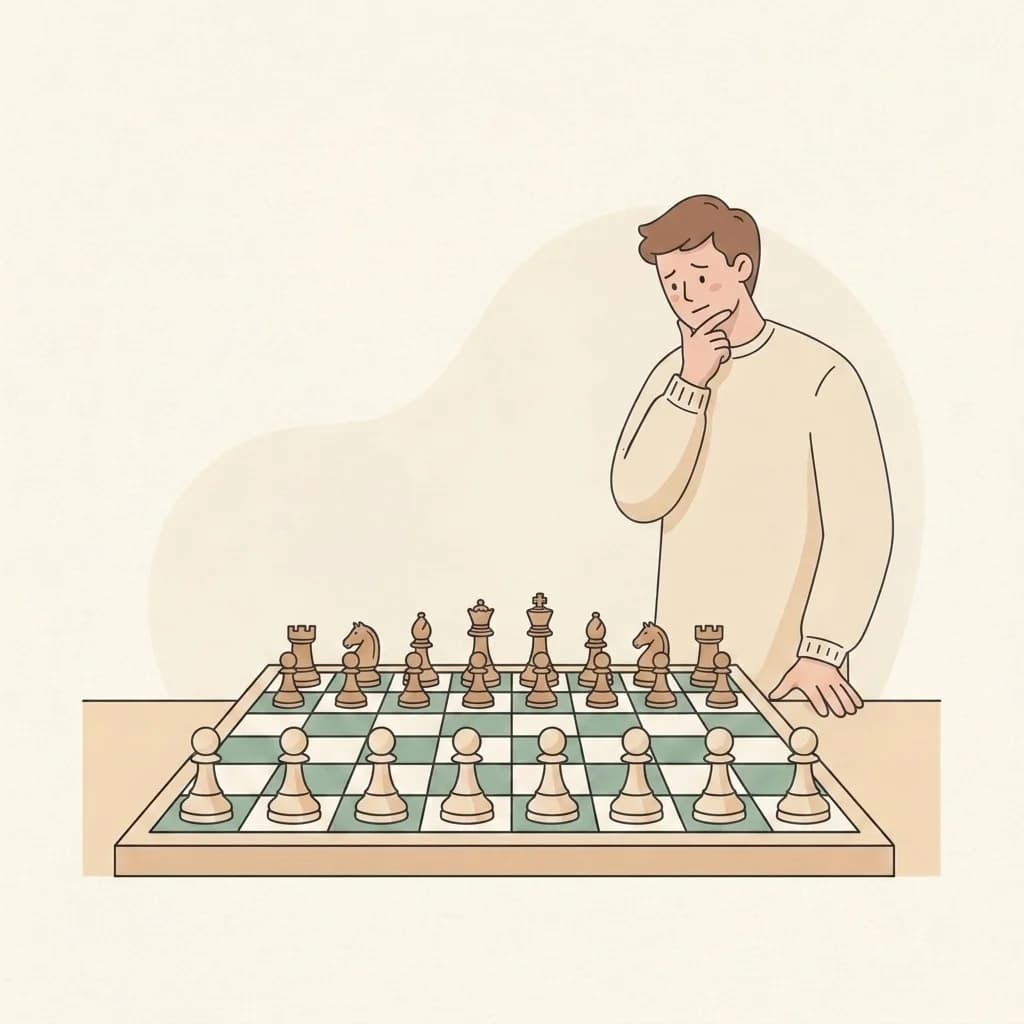
Every square has one coordinate. From White's side, the vertical files run a to h from left to right. The horizontal ranks run 1 to 8 from White's side toward Black's. The bottom-right square is therefore h1 for White, while the top-left is a8.
Always orient the board with a light square in the bottom-right corner. If the board is rotated incorrectly, every coordinate you learn will be wrong. A quick way to build fluency is to point at ten random squares and name each one, then reverse the task: say a coordinate and find it without tracing from the edge.
Coordinates are the grammar underneath both notation and calculation. When a coach asks you to compare a rook on e1 with a rook on e7, you can hold the position in language instead of relying only on a picture. That is why coordinate practice also helps the visualisation work described in how to visualize better in chess.
The chess notation cheat sheet
English notation uses the capital letter of each piece, except the knight, which uses N because K belongs to the king. Pawns have no letter.
| Piece | Letter | Example | Meaning |
|---|---|---|---|
| King | K | Kf2 | King moves to f2 |
| Queen | Q | Qd3 | Queen moves to d3 |
| Rook | R | Re1 | Rook moves to e1 |
| Bishop | B | Bb5 | Bishop moves to b5 |
| Knight | N | Nf3 | Knight moves to f3 |
| Pawn | none | e4 | Pawn moves to e4 |
Printed material can localise those initials. A French scoresheet, for example, commonly uses R, D, T, F, and C. PGN files and most international software use the English letters K, Q, R, B, and N, so a French Cf3 normally appears as Nf3 after export. The squares and symbols do not change.
The destination square is always present. The starting square is normally absent. Write Nf3, not Ng1-f3. Write e4, not Pe4. This economy is what lets an entire game fit on a scoresheet.
The remaining symbols are equally small:
| Event | Symbol | Example |
|---|---|---|
| Capture | x | Bxc6 |
| Check | + | Qh5+ |
| Checkmate | # | Qh7# |
| Kingside castle | O-O | O-O |
| Queenside castle | O-O-O | O-O-O |
| Promotion | =Q, =R, =B, or =N | e8=Q |
Use the capital letter O, not the number zero, for castling. In practice many digital boards accept either, but O-O and O-O-O are the standard forms you should recognise.
How to write a normal move
Build a move from left to right.
- Start with the piece letter, unless a pawn moves.
- Add x if the move captures.
- Add the destination square.
- Finish with + for check or # for mate.
A bishop moving quietly to g2 is Bg2. A bishop taking on c6 is Bxc6. If that capture also checks the king, it becomes Bxc6+. The notation records the result of the move, so do not add a plus sign merely because the piece attacks something else.
Notation practice
Write the move, not the story
Answer six short positions. Each correction explains the exact symbol you need.
Pawn captures are the one common variation. Because pawns have no piece letter, you identify the pawn with its starting file. A pawn from e4 capturing on d5 is exd5. A pawn from c7 capturing on d8 and promoting to a queen is cxd8=Q; add a final + if the promoted queen gives check.
When two identical pieces can reach the same square
Sometimes the piece letter and destination are not enough. If knights on b1 and f3 can both move to d2, Nd2 is ambiguous. Add the starting file of the knight that moved: Nbd2 for the b-file knight or Nfd2 for the f-file knight.
If the pieces share a file, use their starting rank instead. With rooks on e1 and e7 both able to reach e2, the lower rook's move is R1e2 and the upper rook's is R7e2. Only use both starting file and rank in the rare position where neither one alone identifies the mover.
This is called disambiguation. It is not optional decoration: without it, the written game could describe two legal moves.
Castling, promotion, results, and annotations
Castling is written O-O on the kingside and O-O-O on the queenside, regardless of whether you are White or Black. A promotion appends the new piece after the destination: e8=Q, or exd8=N+ if a pawn captures, promotes to a knight, and gives check.
Game results sit after the final move: 1-0 means White won, 0-1 means Black won, and ½-½ means a draw. These belong in a complete game record, but they are not moves.
You may also see !, ?, !?, and ?! in books or analysis. They are comments about move quality, not part of the move's objective description. A player might write Nf5! after analysis, but on a tournament scoresheet Nf5 is enough. Likewise, move numbers such as 12. for White and 12... for Black organise the score; they do not change the notation itself.
A short example from the opening
Take the first moves 1. e4 e5 2. Nf3 Nc6 3. Bb5 a6 4. Bxc6 dxc6.
The pawns use only destination squares. The knights use N plus their destinations. On move three, the bishop moves without capturing, so Bb5 is enough. On move four, Bxc6 includes the capture symbol. Black's d-pawn then captures on c6, so the move starts with its file: dxc6.
Read notation in this order and the game stops looking like a string of codes. Each move answers the same questions: which piece, what happened, and where did it finish?
Common notation mistakes
The most frequent errors are predictable:
- writing P before a pawn move;
- using K for a knight instead of N;
- including the full starting square when no disambiguation is needed;
- forgetting x on a capture;
- writing where the captured piece came from instead of the destination square;
- using 0-0 rather than O-O for castling;
- placing + before the destination instead of after the whole move.
Accuracy matters more than speed at first. In a training game, pause after each move and ask whether it was a capture, check, castle, or promotion. After a few complete games, the symbols become automatic.
Turn the scoresheet into training
A notation sheet is valuable because it preserves your decisions. After the game, mark the moments where you spent too much time, felt unsure, or changed plans. Rebuild those positions before switching on an engine. The notation gives you the evidence; how to use an engine after a chess game shows how to keep the machine from replacing your own diagnosis.
If you cannot yet record a whole game comfortably, start with ten moves from a slow online game. Check the record against the platform's move list, correct your symbols, and repeat. The goal is not calligraphy. It is a readable game that lets you study the choices that actually cost you points.
Key takeaways
- A move normally contains a piece letter and destination square; pawn moves omit the letter.
- Add x for a capture, + for check, # for mate, and = followed by the new piece for promotion.
- O-O and O-O-O record castling.
- Add a file or rank only when two identical pieces can reach the same destination.
- Use your finished scoresheet to reconstruct the game before asking an engine.
Notation is not busywork. It is the bridge between playing a game and learning from it. Once you can record the moves without breaking concentration, the next useful skill is finding where the game truly changed. The practical process is in how to find the turning point in a chess game.