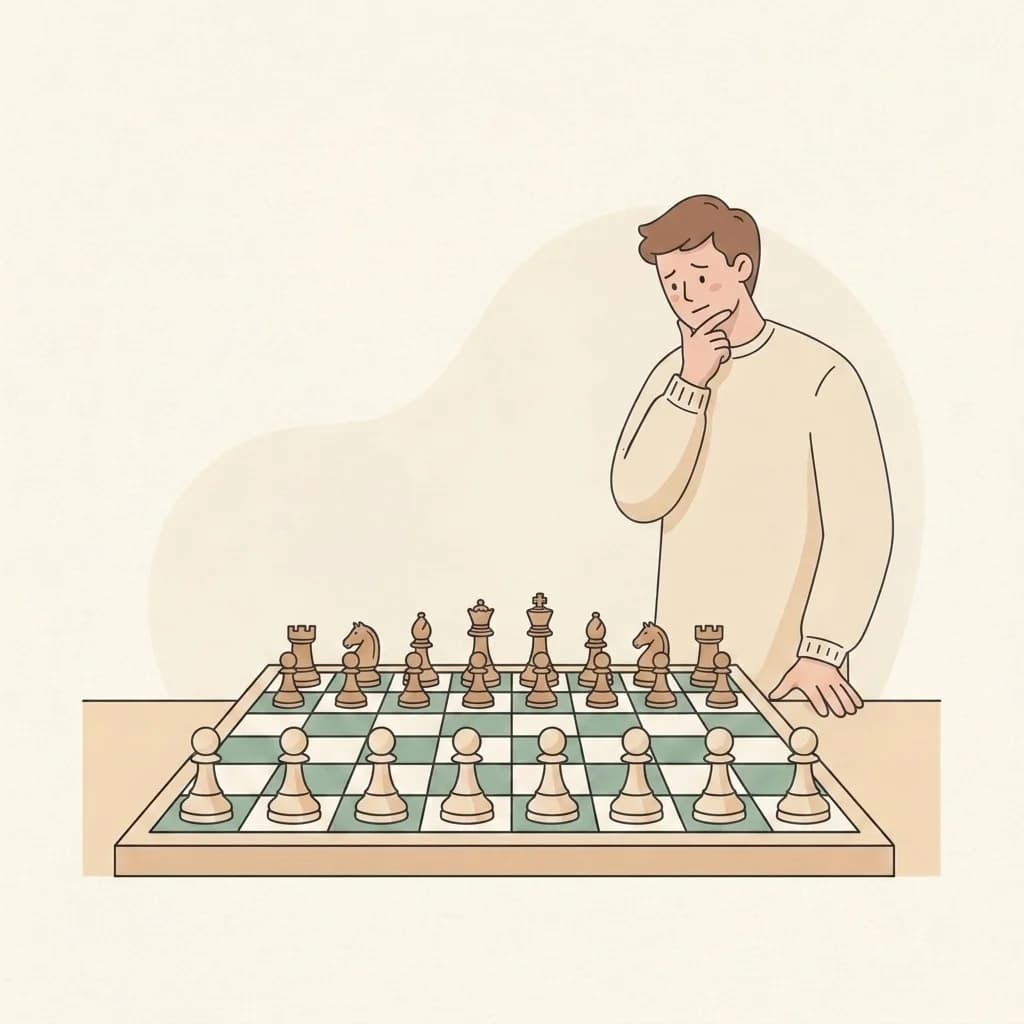

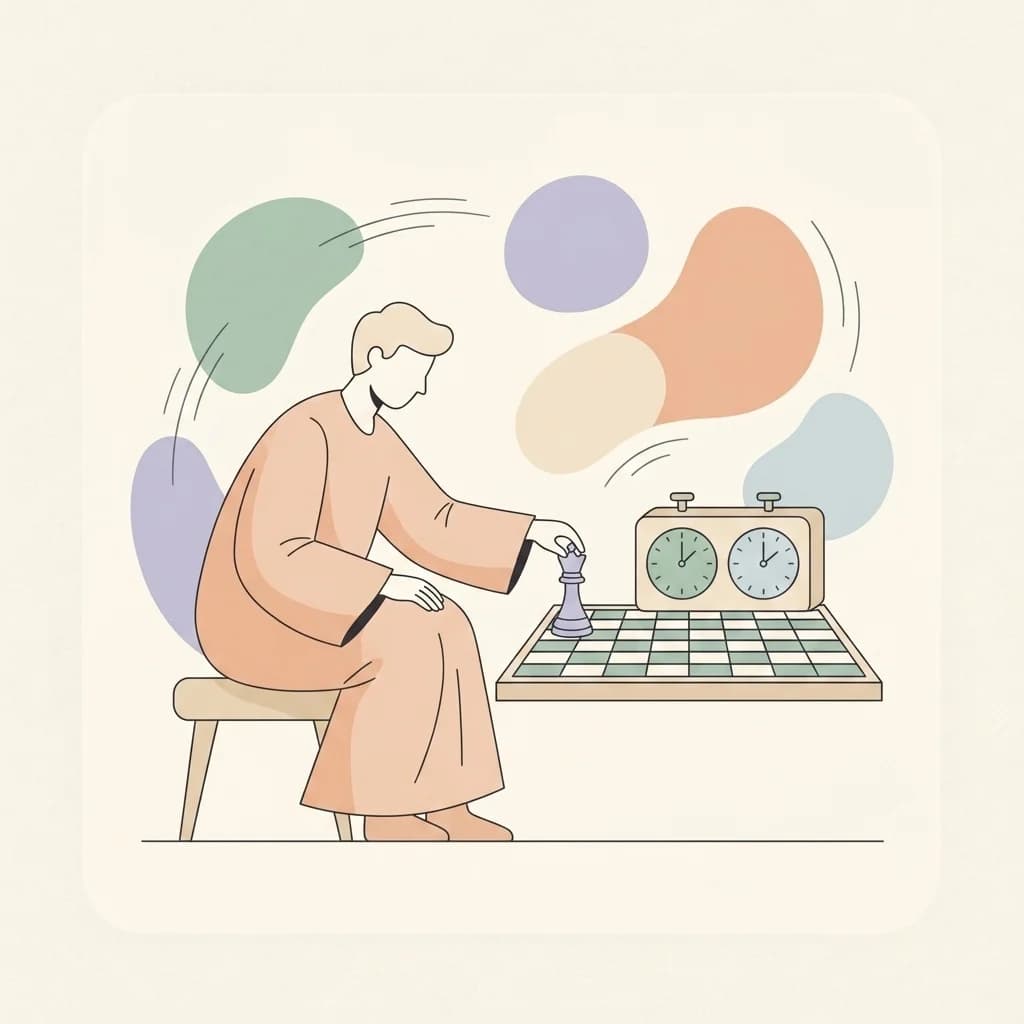
When a student tells me "I keep losing on time", I already know the real problem will not be how fast his fingers move. It will be how he sorts his decisions.
Which format grows your game fastest?
Strong players do not think faster than you. They do not always calculate deeper either. What sets them apart is knowing when time deserves to be spent and when it does not. An automatic recapture and a strategic turning point do not get the same attention, and that hierarchy becomes visible around 2000 Elo. It is one of the habits I describe in what 2000-rated players do differently.
The club player usually does the opposite. He burns five minutes on an obvious recapture, then plays a complex endgame at ten seconds a move. That is not a speed problem. It is a priority problem.
Sorting happens before calculating
Many players think "good clock management" means "play fast in easy positions". That is partly true, but it misses the real mechanic.
Before deciding how much time a move deserves, strong players sort the position into three categories. Are we in a natural, almost forced move? In a position where several options hold the line without changing the evaluation? Or in a moment where one single decision can rewrite the game? That sorting takes a few seconds, but it conditions everything else.
The player who never does this sorting spends time at random. Sometimes he thinks too long on an obvious move out of caution; sometimes he rushes a critical choice because he already hesitated too much earlier. In both cases, the clock is not what betrays him. What betrays him is the absence of a framework for deciding where to invest.
Slowing down only when the position shifts
Strong players slow down at specific moments, not "whenever things feel hard". They slow down before decisions that commit the next ten or fifteen moves.
Here are the moments that truly deserve real thinking:
- choosing between several pawn breaks
- deciding a trade that changes the pawn structure
- evaluating a direct king attack
- calculating a forced sequence to the end
- entering an endgame with an unclear evaluation
Almost all of these are irreversible. Once played, they set the direction of the rest of the game. You can mess up a developing move and recover on the next one; you will not recover from a hasty queen trade or a miscalculated pawn break.
Conversely, strong players speed up clearly on decisions that add no new information. Recapturing a hanging piece, putting a knight on its natural square, or tucking the king to safety does not justify a long calculation. Mental budget is finite, and spending it on routine moves steals it from the moments that matter.
Keeping a reserve for the sharp phase
Good clock use is not judged move by move. It is judged by the state of your clock when the game becomes truly sensitive. Strong players almost always try to reach the critical phase with a real reserve. Not necessarily fifteen minutes, but enough to think cleanly across two or three hard decisions.
If you enter the last third of the game in survival mode, you no longer play the right moves. You play the ones your clock fear allows you to play. An endgame still demands clarity, a decisive attack even more. The student who tells me "I had a winning position but I lost on time" usually does not have an endgame problem. He has an upstream distribution problem.
This does not mean saving at all costs. If a genuinely important position asks for seven minutes, invest them. The point is to avoid burning them on a position that does not deserve them.
Calculate from candidate moves, not from anxiety
A running clock pushes your thinking into disorder. You look at one move, hesitate, jump to another, lose the thread. Strong players avoid this trap by imposing an order on their calculation.
The method holds in a few simple steps:
- spot the immediate threats on both sides
- identify two or three serious candidate moves
- start with forcing moves (checks, captures, direct threats)
- compare lines only after that selection
This framework does not guarantee you find the best move, but it guarantees your time serves something. A player who calculates before knowing what to compare keeps circling. He spends three minutes on an idea he abandons later, then tries to rebuild under pressure. That is where the costliest mistakes happen.
If you want to build that discipline, it grows mostly inside your own post-game analysis. Reviewing where you spent time for nothing teaches you to recognize false alarms in real time.
Speeding up in positions you already understand
The flip side of slowing down is deliberate acceleration. When the position is technical, familiar, or simple, strong players do not try to prove their seriousness by thinking longer. They execute.
A king-and-pawn endgame with an active king, a familiar closed structure, a development position where the plan is obvious: in all of those, ten minutes of thought does not improve the decision. It delays it, and it steals time from the next one. Strong players do not confuse caution with slowness.

This is where the 2000 Elo difference often shows. The strong player is not trying to "use all his time". He is trying to use the right time in the right place. A 1600-rated student recently told me he wanted to "feel every move"; in reality, he was scaring himself on routine positions and arriving empty at the moments that counted.
Not letting the clock decide for you
When time runs low, many players switch into another mode of play. They play fast not because the position demands it, but because they are scared of flagging. That is when the clock takes over.
Strong players try to avoid that switch, even under real pressure. They hold the same core logic: check the threats, pick a realistic plan, play the move that still holds after the opponent's best reply. They also accept that in a difficult position, the right move is not always the perfect move. It is often the most resistant move, the one that maximizes practical chances to complicate.
Put another way, when the game is bad, they do not try to "solve" the board. They try to stay alive in the most stubborn position possible. That is a mental skill as much as a technical one.
What you can apply in your next game
If you want to manage time like a stronger player, do not start by counting seconds. Start by sorting your decisions.
A simple, testable rule for your next game: play routine moves fast, slow down only when the structure, the tactics, or the transition truly change, and keep a reserve for the final phase. Do not calculate until you have listed two or three candidates first. After the game, reopen the file and note the two or three moments where you overspent for nothing. That observation, repeated over ten games, is worth more than any generic advice on "clock management".
To frame this work inside a broader method, how to improve at chess efficiently gives you the larger system that clock management fits into. And if you notice you keep losing on time despite decent technical play, that is exactly the kind of problem I fix with students in private coaching; you can see the formats on the services page.
What to remember
Strong players do not win because they think faster. They win because they know where to place their time, where to accelerate, and where to keep reserves.
The useful lesson is therefore not "play faster". It is to recognize the moments that truly deserve deep thought, then to preserve enough energy for those moments. The rest of the time, execute.
Watch one thing during your next serious game: where did you spend your time, and did that moment actually deserve that spending? If the answer is no two times out of three, you have your next project.