
Many good games are wasted on small advantages.
What kind of player are you really?
The position is better, but not enough to win by accident. Rush it, and you hand the game back. Drift, and the opponent gets time to solve the problem. Conversion is the skill in between: you make the position easier, you kill counterplay, and only then you collect the point. The classic trap is wanting to turn that edge into a decisive attack immediately. You force, you calculate too early, you open the position at the wrong moment, and you make the opponent's counterplay easier. Conversion needs almost the opposite: patience, precision, a clear priority order. That is also one of the clearest gaps between club players and stronger opponents, as I cover in the three pillars of chess improvement.
Identify what your advantage actually is
Before you try to convert, you need to know what you are converting. Not every edge calls for the same plan, and playing "actively" without a guiding idea is usually the first step back toward equality. A better pawn structure calls for fixing a weakness before attacking it. A more active piece asks you to improve the coordination of the rest before simplifying. More space mostly asks you to restrict the opponent. A better potential endgame justifies some trades, not all of them.
Ask yourself one plain question: what exactly makes my position better here? Until you can answer in one sentence, you do not have a plan, you have an impression. An impression converts nothing. The mirror mistake is believing that a small edge has to produce a forcing sequence right away. You go hunting for a sacrifice, a break, a direct attack. Sometimes that exists. In most positions, a small advantage converts through accumulation, not violence.
First priority : improve your worst piece
This is probably the most useful rule I give in this type of position. When you have a small advantage, you do not need to do something special every move. You need to improve your army in a coherent way.
The useful question is almost always the same: which of my pieces is the least useful, and how do I make it better? Bringing a rook to a half-open file, rerouting a knight to a better square, freeing a passive bishop, centralizing the king in the endgame, connecting the rooks before opening the position: these are quiet but decisive moves. Why are they so strong? Because a small advantage becomes much easier to convert when all your pieces participate. If you attack with two pieces while a rook and a bishop sit passively, you hand the opponent the tempos they need to reorganize.
Second priority : kill the counterplay
A tiny edge becomes much heavier as soon as the opponent has no clear counterplay. Average players think about their own plan first. Stronger players also think about what their opponent would do with an extra tempo, and play against that plan.
On every move, ask yourself: which freeing pawn break do they want, which piece do they want to activate, which trade would let them breathe, which file or diagonal could hand them the initiative? Then play against it. Stop the pawn push, control the entry square, keep the passive piece passive, refuse the trade of their bad piece for your good one. Converting a small advantage is not only about improving your own play. It is also about keeping the opponent's position uncomfortable to play.
Fix weaknesses before attacking them
A mobile weakness is not yet a real exploitable weakness. If you want to attack an isolated or backward pawn, you first need to make sure it cannot advance, be traded off, or be defended through dynamic counter-activity.
The logical sequence is almost always the same: you spot the weakness, you cut the dynamic resources that compensate for it, you place your pieces on the right squares, and only then you start direct pressure. Many players skip the middle two steps. They attack too early, which lets the opponent activate their pieces through the defense itself. A properly fixed weakness is a stable target ; a weakness attacked too soon often becomes a pretext for opponent activity.
Simplify by logic, not by comfort
Simplifying when you are better is often a good idea, but not any way. The wrong reflex is to trade automatically the moment you feel a slight edge, under the banner "endgames are better." Sometimes true, sometimes not.
Before any trade, the good questions are clear: does this trade actually reduce the opponent's counterplay, does the resulting endgame highlight my structural edge or activity, am I trading my good piece for their bad one, does this trade free a square for them? A good simplification leaves you with a position that is both simpler and more pleasant. A bad simplification leaves you with a position that is simpler but easier for the opponent to hold. To sharpen this transition reflex, how to study endgames without getting lost is the right companion read.
A three-step plan is enough
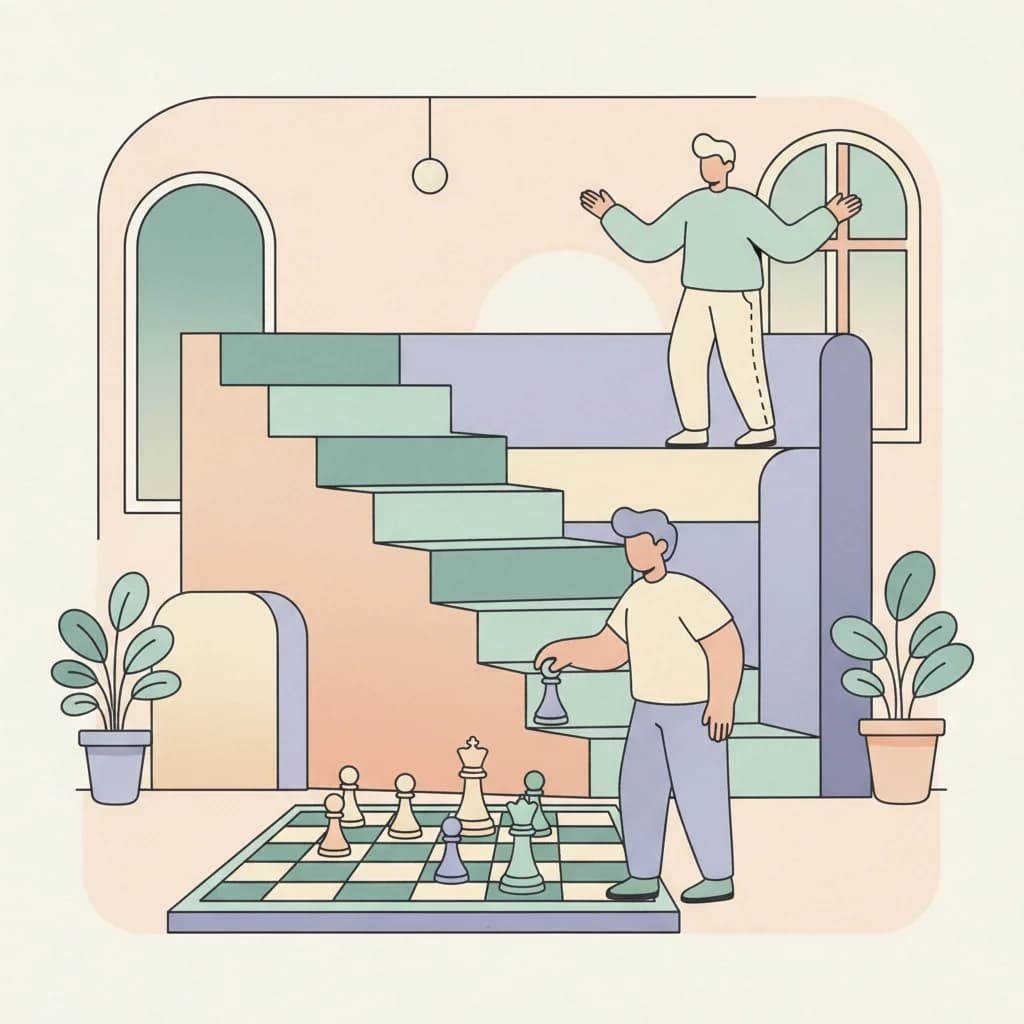
In a slightly better position, look for a simple plan, three improvement moves maximum. For example: improve the rook to the half-open file, fix the opponent's weak pawn, trade off the main defender. That type of plan is vastly more powerful than a vague intention like "keep up the pressure." It also gives you an analysis frame after the game: if conversion fails, you can pinpoint the moment the plan fell apart. That is exactly the work done in how to analyze your games.
The signs you are blowing your advantage
A few warning signs keep showing up: you start repeating threats without improving your pieces, you trade without knowing what the endgame adds, you open the position before your pieces are ready, you chase a tactic because you "feel" you should be winning, and you allow obvious counterplay because you only look at your own plan. Most modest advantages are not lost to a big blunder. They are lost to a string of slightly too rushed decisions. When you feel you are chasing the position, that is the moment to slow down, not speed up.
The checklist to run next game
When your position feels a shade better, run through a short checklist:
- what is my concrete advantage?
- which is my worst piece?
- what counterplay does the opponent want?
- which weakness can I fix?
- is this the moment to open, or to improve?
That frame blocks the two opposite mistakes: playing passively and letting the advantage evaporate, or forcing too early and losing control. You are not trying to win immediately, you are trying to make the position easier for you and more unpleasant for them.
What shifts when the method holds
Converting a small advantage in chess is not about accelerating the game artificially. It is about making it progressively more favorable, simpler for you, harder to defend for them. Improve your pieces, kill counterplay, fix weaknesses, simplify when the logic of the position justifies it. That is how a slight edge turns into a full point.
If you want to build this conversion reflex in slow games rather than hope for it move after move, JD Chess coaching exists precisely for that. The goal is not only to see that you are better ; it is to know what to do the moment you are.