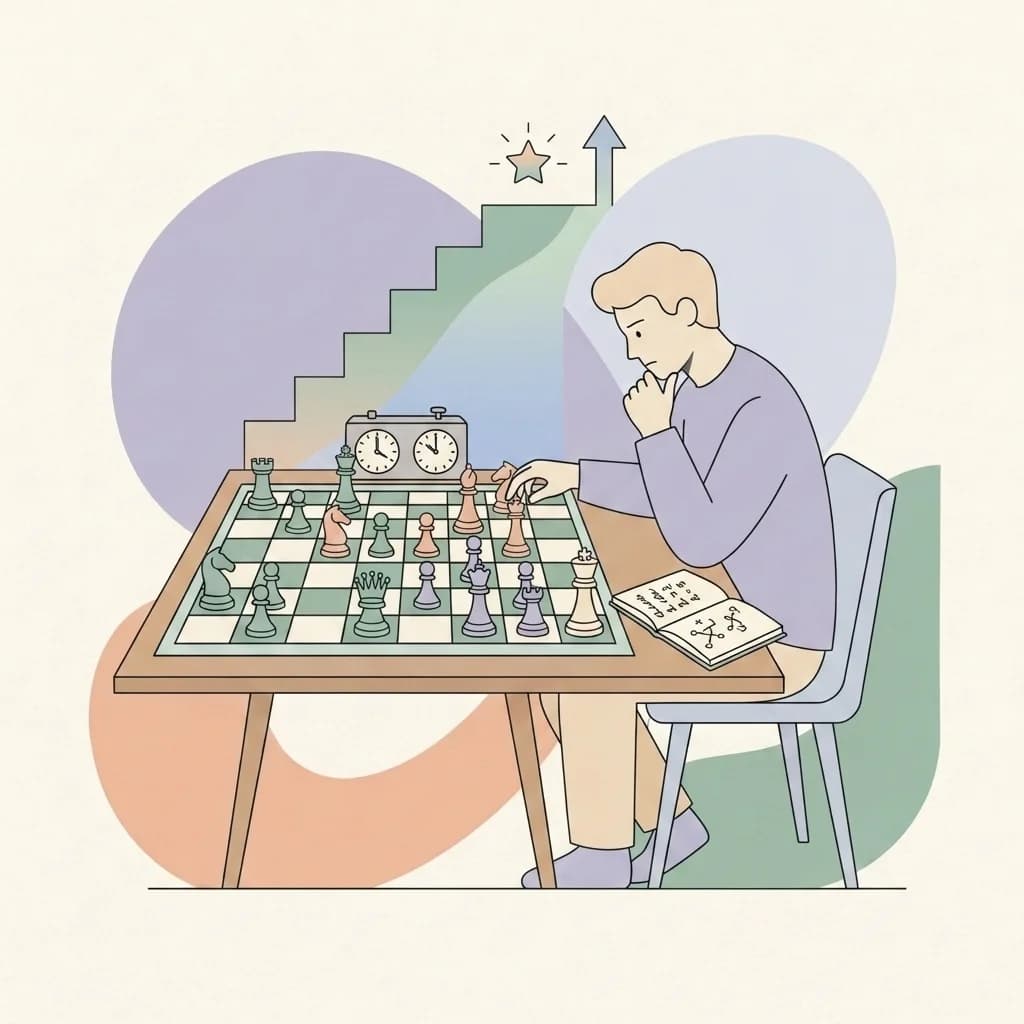

"I work, I play, I watch content… but I’m stuck."
Why has your chess improvement stalled?
That’s the sentence I hear most often from motivated players. In almost every case, the problem isn’t motivation or talent. What breaks is the match between your effort and what your game actually needs to correct.
A plateau doesn’t mean you’ve hit your ceiling. It means your training stopped lining up with the real problem. The good news: that gap is almost always diagnosable. And once you diagnose it, you can close it. If you are stuck specifically in the 1000-1500 range, how to go from 1000 to 1500 Elo maps the exact climb.
A plateau is a signal, not a verdict
Players often read their plateau as proof of a ceiling: "maybe I’m just not built to improve past this." Below 2000, that explanation is rare. What usually plateaus isn’t your potential; it’s your method. It also helps to know what the number really measures: what is Elo in chess shows why a stalled rating is a signal, not a verdict.
You can stay stuck for months while doing plenty of things that look useful: puzzles, blitz, videos, a bit of opening study, some casual analysis. Stacking activities doesn’t create progress. If your work doesn’t answer a clear problem, it turns into noise. Before trying to do more, you need to understand why you’re stuck.
You confuse activity with progress
Look at a typical week. How many blitz games, how many puzzles, how many games did you actually review? If you played twenty and analyzed zero, you didn’t train; you filled time. The students I see improve fastest often play less than average, but they close the loop after every serious game: one mistake identified, one priority for the week, one targeted exercise. The opponent mix matters here too: should you play stronger players or same-level opponents explains how to get the right kind of feedback from your games.
The useful question isn’t "how much did I do today?" but "what did this change in my game?". If you can’t answer that, you’re not improving, you’re occupying time. That’s exactly how players stay stuck for three years while feeling serious about their work.
Ask this at the start of every training block: what am I trying to correct, and how will I know it worked? If you don’t have both answers, the block is too vague. Rewrite it before you start.
You work without a clear diagnosis
A plateau often comes from studying what reassures you rather than what treats the real problem. You think your issue is openings, but you actually lose in the transition to the middlegame. You believe you lack tactics, but your real weakness is the lack of a plan. You want to "study more" when what you really need is to analyze what you already play, better.
A good diagnosis starts with real games, not intuition. Open your last ten losses and look for the pattern: when does the position stop feeling comfortable, what type of mistake returns, where do you stop calculating? Three games is often enough to surface two clear priorities. Without that diagnosis, you’ll keep studying what you enjoy, not what’s actually costing you rating points.
For a structured method on this point, start with how to improve at chess efficiently. The core principle is simple: extract two or three sharp priorities instead of training in a fog.
You change priorities too often
The other hidden driver of plateaus is instability. You work on a theme for three days, a video crosses your feed about something else, you switch. You revise your plan every week based on mood, the latest loss, or whichever new idea caught your eye.
This feels dynamic, but it kills repetition, which is the only mechanism that makes a theme truly automatic in your games. A weakness needs several weeks on the same axis before it corrects. If you change priorities before the theme actually shows up in your play, you interrupt the learning before it produces anything.
Discipline isn’t glamorous, but it’s what separates players who improve from players who spin in place. Pick an axis, hold it six weeks, then evaluate. On this exact point, how to stop studying chess randomly gives you the framework.
You review games without extracting the pattern
There’s a big difference between "scrolling through the game with the engine" and "analyzing the game". The first one means you watch the evaluation bar change, nod, and move on. The second one means you replay without help, note where you hesitated, identify the real turning point, classify the mistake, and pull a theme out of it.

Most stuck players analyze in a way that doesn’t change their next training block. They see mistakes but don’t extract a pattern. Without a pattern, every loss is an isolated event; you suffer the game, but you capture nothing reusable for the next one. For a concrete review framework, read how to analyze your games.
How to restart progress in six weeks
Breaking a plateau doesn’t require a revolution, it requires a refocus. The framework I give stuck students most often holds three rules: a short cycle, a single priority, a repeatable weekly routine.
A week of the cycle looks like this:
- one serious game analysis
- two targeted sessions on the main weakness
- one or two slow games (30 minutes minimum)
- a brief weekly review
For those six weeks, you hold the same priority and accept cutting the rest: less blitz "to stay sharp", fewer videos on unrelated topics, less scattered curiosity. The point isn’t to bore you, it’s to make your work readable. If the priority has moved in your games by the end of the cycle, keep going. If not, adjust the method, but don’t jump to a new theme every three days.
When a coach changes things
A plateau becomes especially frustrating when you feel your effort is honest but nothing translates into results. At that point, a coach isn’t there to teach you the whole game. The real job is narrower: diagnose correctly, pick the right priority, reorder the training, and measure what’s actually changing.
Put differently, coaching mostly shortens the gap between "something isn’t working" and "I know exactly what to fix". If that’s what you’re missing, take a look at JD Chess coaching. The goal isn’t lifelong outside support; it’s getting back to a clear, measurable trajectory that matches your level.
What to remember
If you plateau, don’t assume you simply need to work more. In most cases, you already work enough. What’s missing is a precise diagnosis, a stable priority, real game analysis, and a cycle that closes the loop between training and actual play.
A plateau isn’t a verdict on your potential, it’s a signal about your method. Less activity for its own sake, more clarity, more structure, and progress restarts.