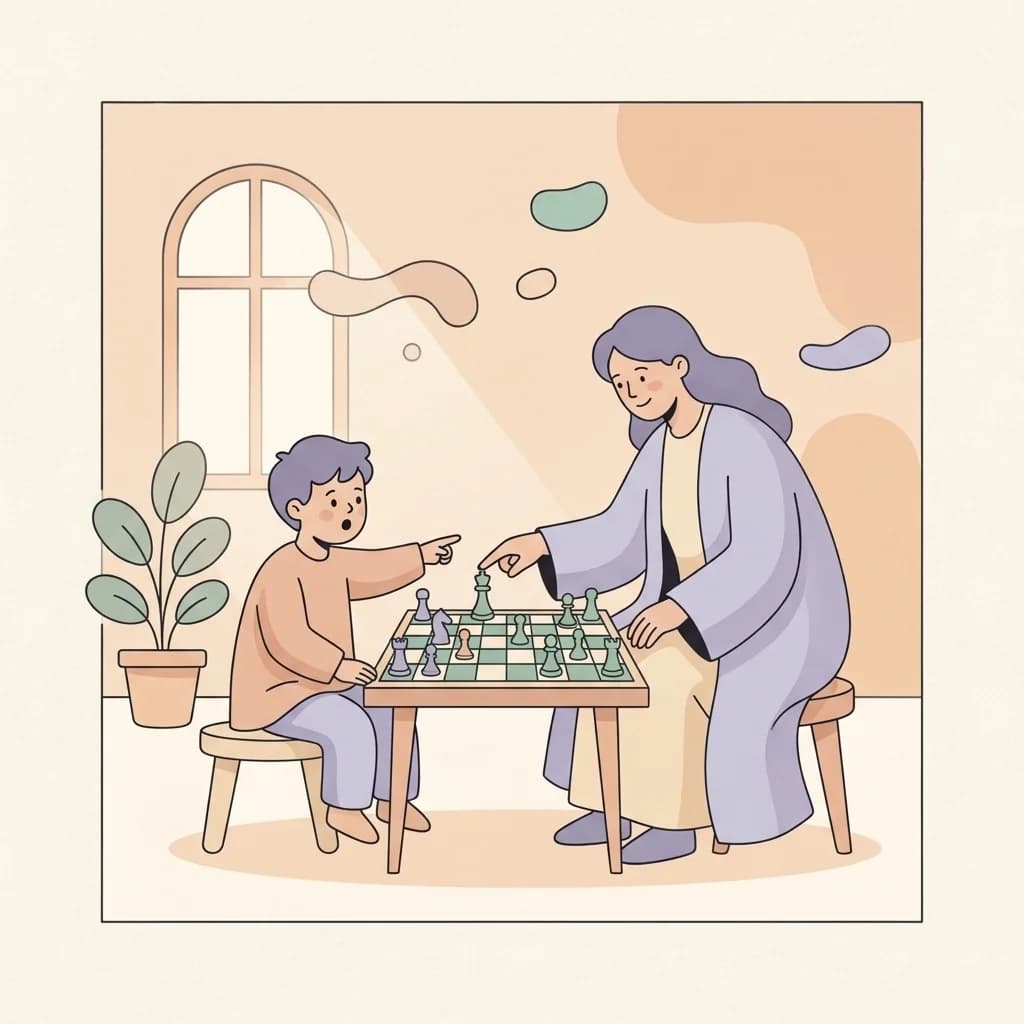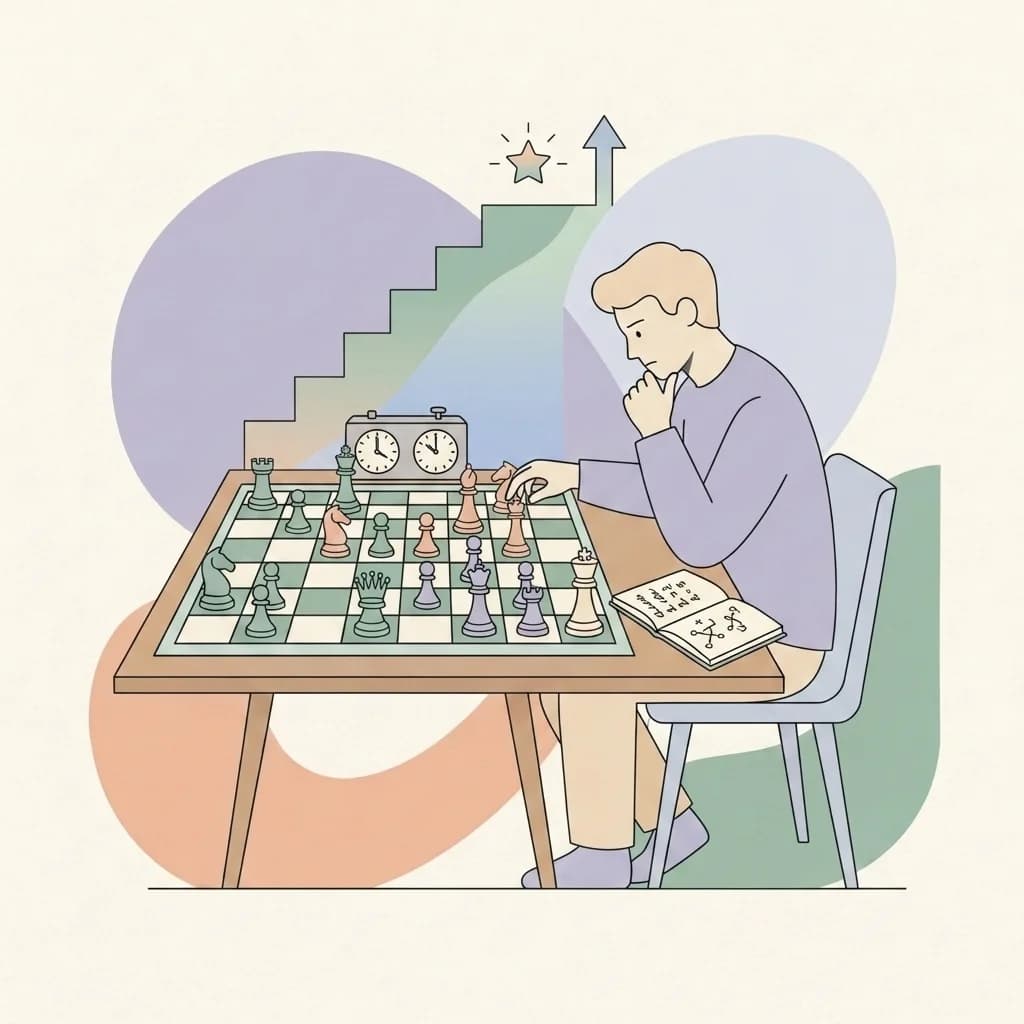


"Should I play up or stay at my level?" is one of the first questions my students ask when they start taking training seriously. They expect a clean answer. The honest one is less clean: both matter, and the mistake is usually to pick one and forget the other.
What kind of player are you really?
What matters is not the opponent's rating. It is the feedback you need this month. Stronger opponents and same-level opponents teach different things, and if you only get one of them, your training tilts in a way that slows progress down.
A stronger opponent raises the bar you actually play at
When you play someone clearly above you, the position stops forgiving you. Small drifts get punished, defensive tricks fail, and the slow squeeze you could wriggle out of at your level suddenly converts. That is uncomfortable, but it is also where you see what your real game looks like when nothing lets you off the hook.
Most of my students discover the same thing after a handful of serious games against stronger opposition: they were not "almost" there in their own bracket. They were winning because the opponent's technique was shaky too. Against a player 200 points up, their own lazy moves stop sliding past. You cannot get that signal from an equal-level game. It is the main reason stronger games belong in your calendar, even if they feel rough for a stretch.
That said, the gap matters. Playing someone 500 points above you mostly produces survival, not learning. You react, you defend, you lose without understanding where. The sweet spot is roughly 100 to 250 points above your current level: enough to punish you cleanly, not so much that the whole game becomes damage control. If this is your first serious stretch against stronger players, pair it with how to analyze your games so the pressure actually turns into lessons. The rating math behind that range comes straight from the FIDE Elo system, where expected scores shift sharply once the gap passes about 200 points.
A same-level opponent shows you your real habits
Games against opponents at your level are where your actual game gets tested. Neither side has a huge edge in technique, so the result hangs on your decisions: your opening understanding, your plan in the middlegame, your conversion in the endgame. That is the cleanest source of diagnosis you have.
Stronger opponents teach you what is possible. Same-level opponents tell you what you actually do under normal conditions. If your tactics always collapse around move 25 against peers, that is real information. If you reach a winning endgame but cannot convert, that is real information too. Stronger players would have won those positions for you by playing accurately. Same-level games force you to do the work yourself, and the gap between what you know and what you play becomes visible.
This is why students who only play up often feel like they are working hard without improving. They get exposure, but the games are too lopsided to isolate their own pattern. When I ask them to play six serious games at their level and review each one seriously, two or three recurring mistakes jump out immediately. Those are the leaks. Without same-level games, you rarely see them clearly.
Why you need both, not one
Treating the question as either-or is the real mistake. Stronger opponents stretch you; same-level opponents diagnose you. Drop one and your training loses a leg.
If you only play stronger players, you get punished constantly but you never see what your default game looks like when the position is fair. You start playing "not to lose", which is a different skill from playing to win and not always the one you need. If you only play same-level opponents, you stay in your comfort zone: you win enough games on pattern recognition alone, and the moves that would fail against real technique keep surviving. You plateau without noticing, which is exactly the trap covered in why you plateau in chess.
The weekly balance I give most students is simple: the bulk of your serious games at your level, a steady minority against stronger opposition. Review both with the same honesty. The same-level games tell you what to fix, the stronger games tell you whether the fix is holding up under pressure. That combination is what the three pillars of chess improvement calls collecting real evidence.
When to tilt toward stronger opponents
There are stretches where you should deliberately play up more. The clearest signal is when your level feels easy. If you are winning the majority of your same-level games, if the positions you reach no longer challenge you, if the review does not surface a clear recurring mistake, you have outgrown that bracket for now. Staying there only builds confidence you cannot back up once you face real resistance.
The second signal is when you know your weakness is technical rather than structural. If your tactics are fine but your positional play breaks down the moment someone plays a quiet, patient game, you need stronger opponents who will not hand you tactical gifts. They force the kind of play you are trying to learn. Same-level opponents will keep giving you the tactical middlegames you already handle, and your positional understanding will not move.
Slow time controls magnify this effect. A 30+0 or 45+15 game against a stronger player gives you time to actually watch what they do: how they improve a piece you would have left alone, when they trade, when they refuse to trade, how they build pressure without an obvious threat. That is visible study, and it transfers faster than any video. Pools on Lichess and Chess.com make this easy to schedule: filter the seek by rating range and time control, and you can build the exact mix in one sitting. If your weakness is strategic drift, this is where strategic imbalances starts clicking.
When to tilt toward same-level opponents
The opposite stretches matter too. If you are losing most of your games, if your confidence is visibly shaky, if you cannot even tell what the mistake was because the position was already bad by move 15, stop playing up for a while. You are not learning. You are getting flattened, and your self-diagnosis is noisy because there is too much wrong at once.
Go back to your level and rebuild the signal. Same-level games give you positions you can actually handle, which means you get a real middlegame, a real endgame, and a real chance to test whether the fix you trained is showing up under normal conditions. Confidence matters in chess; it is not just a feeling. A player who has stopped trusting their own calculation will hesitate, burn time, and lose on the clock even in winning positions. Rebuilding that trust takes games you can actually play from start to finish.
This is also the right tilt when you are coming back from a break, testing a new opening repertoire, or working on a specific weakness you need to isolate. Stronger opponents add too many variables; same-level games let you see whether the one thing you trained is doing what it should.
The rule I give students in one sentence
Play stronger opponents when you need to be challenged. Play same-level opponents when you need to be diagnosed. That is the whole framework.
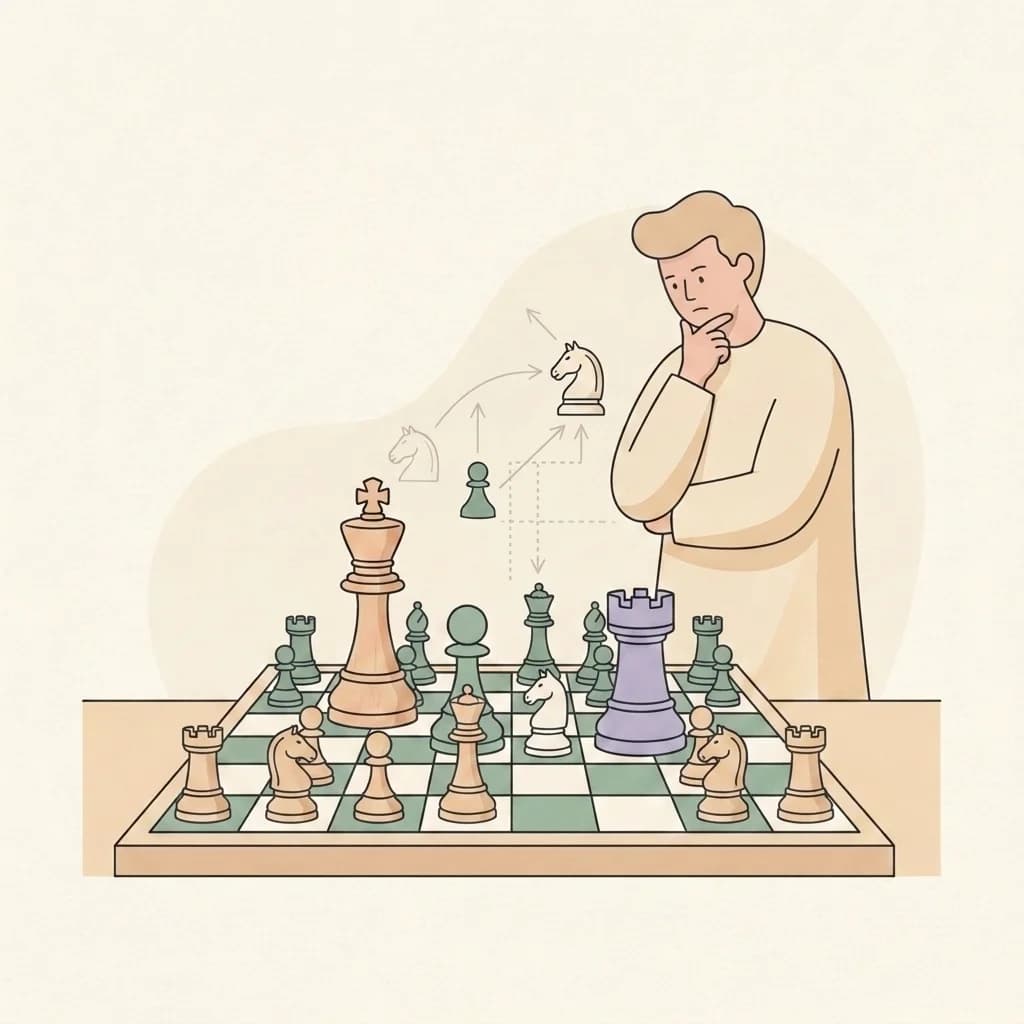
If every game feels easy, move up. If every game feels like chaos, come back down and get your signal clean. The point is not to pick a camp; it is to use each type of game for what it is good for. The mistake most improving players make is picking one based on ego (always playing up to feel serious) or comfort (always playing down to keep winning) rather than based on what their training actually needs right now.
The process still matters more than the opponent
The opponent you pick matters, but the way you treat the game matters more. A serious game against a stronger player teaches you almost nothing if you blitz through the review, look at the engine for ten seconds, and move on. A same-level game teaches you a lot if you replay it without help, find the moment the position turned, classify your mistake, and convert that into one concrete training priority for the week.
That is the habit that separates players who improve from players who spin in place. How to review a lost chess game walks through the exact sequence I ask my students to run after every serious loss. Without that step, the opponent-selection question becomes cosmetic: you are optimizing the input to a broken system.
The loop that actually produces improvement is narrow. You play a serious game, review it without excuses, name the recurring pattern, train that pattern deliberately, then test it in the next game. Keep that loop intact and you progress against either type of opponent. Break it, and no amount of strong-opponent exposure will do the work for you. Pattern training between games gets cleaner on a spaced repetition tool like Chesstempo, which tracks the motifs you keep missing instead of letting you grind random puzzles.
How to build your mix in practice
If you want a concrete weekly template, here is what I recommend for someone playing roughly three to five serious games a week:
- two or three games at your level for diagnosis
- one or two games against players 100 to 250 points above you
- one slow game per week minimum (30+0 or longer)
- review every game the same day or the next
- one training theme for the week, tied to the mistake you just found
That split keeps your signal clean and your ceiling stretched at the same time. Adjust the ratio based on what your last round of reviews showed. If your level feels easy for two weeks in a row, add more stronger games. If you are drowning, go back to mostly same-level and rebuild.
Long term, the ratio shifts as you improve. A player climbing out of 1200 needs mostly same-level opponents because there is so much raw pattern recognition to build. A player at 1800 who has stopped improving usually needs more stronger-opponent exposure, because same-level games no longer surface the ceiling. If you are specifically working through the 1000-1500 stretch, how to go from 1000 to 1500 Elo frames the opponent mix for that exact climb. If you want a fuller structure around this, chess training routine lays out the weekly frame.
Final answer
Do not treat this as a one-time choice. Play stronger opponents when you want to see what good chess punishes in your game. Play same-level opponents when you want to see what your own game actually does under normal conditions.
The best training environment contains both, with your review process deciding what each game means for the next step. Pick the wrong opponent for the week you are in and you waste the game. Pick the right one and every session closes a little more of the gap between what you know and what you play.
Key takeaways
- Stronger opponents (100 to 250 Elo above you) stretch your ceiling; same-level opponents diagnose your real habits. You need both.
- Past a 300 Elo gap, feedback gets noisy: you survive instead of learning.
- Weekly mix for most students: 60 to 70 percent same-level games, 30 to 40 percent stronger, plus at least one slow game (30+0 or longer).
- Tilt up when your level feels easy, tilt down when every game feels like chaos.
- The review loop matters more than the opponent. Without honest post-game analysis, opponent choice is cosmetic.
If you want a coach to set the right mix for your level and run the post-game reviews with you, see the JD Chess coaching options.