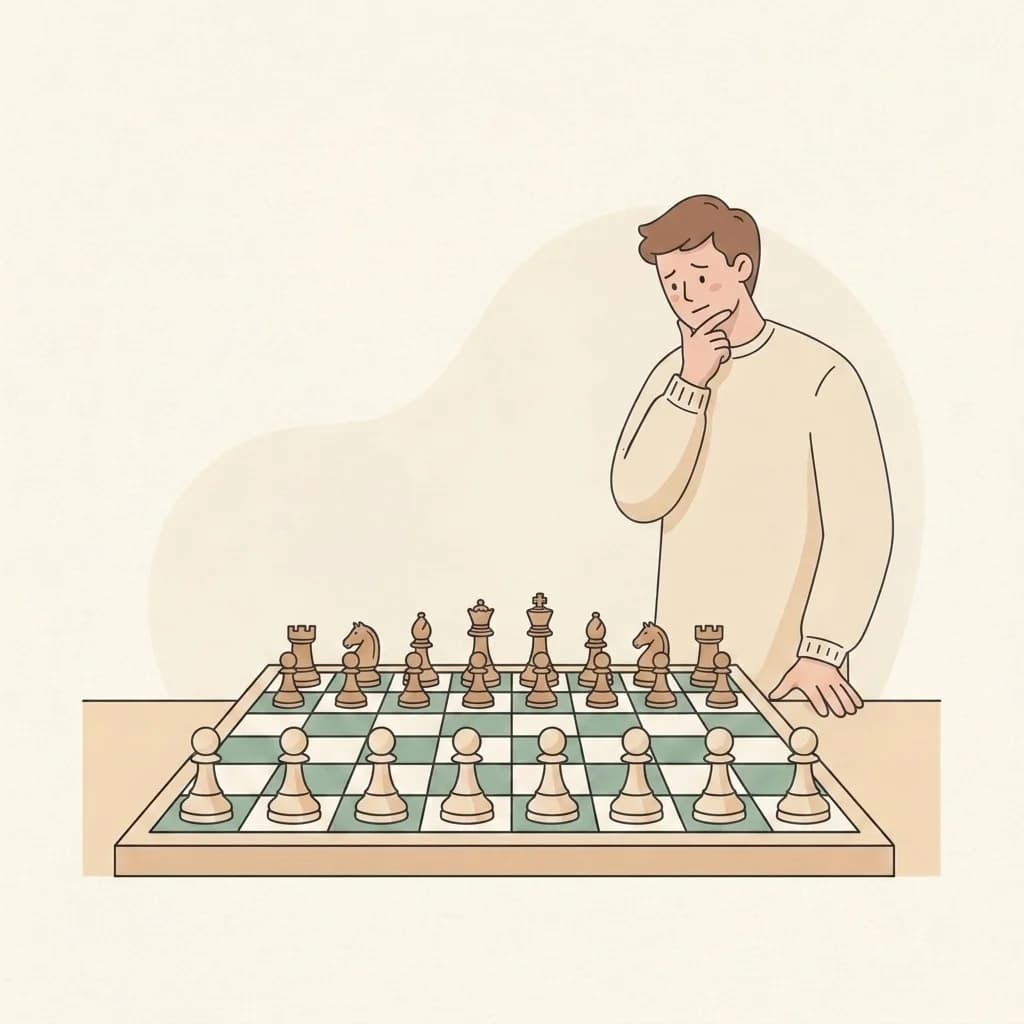

Managing your time well in chess is not about avoiding the flag. It is about keeping the clock from playing your moves for you twenty moves before the end.
What kind of player are you really?
With most club players, the same scenario repeats game after game: they think for a long time in positions that are still simple, they hesitate on routine moves, and they reach the critical phase with two minutes to decide everything. At that point their level collapses — not because they are weak, but because there is nothing left on the clock to think properly with. The good news is that this is a method skill, not a speed skill.
The real problem is not a lack of time
When a player says "I manage my time badly", they usually think they need to play faster. That is rarely the right diagnosis. Most of the time, the problem is that they spend a lot of time on the wrong decisions and very little on the ones that matter. Two players can burn the exact same total number of minutes and play completely different games, because one kept their reserve for the critical moment while the other torched it on three development moves.
Time management is therefore not about overall tempo. It is about hierarchy. As long as you treat every move as equally important, you will always burn your clock at the wrong moment, at any time control. The real lever is learning to recognize which move genuinely deserves thought and which move can be played in fifteen seconds without risk.
Do not spend the same energy on every move
During a game, moves are not equal. Some are execution moves where the position already hands you the answer: developing a backward piece, answering an elementary threat, recapturing an obvious exchange. Others change the structure permanently, open a king, launch a tactical sequence, or determine the endgame. Between the two there is a one-to-ten ratio in decision weight. Your time should follow that ratio.
The reflex to break is spending four minutes on a semi-forced move at move six, then playing a strategic transition in thirty seconds because the clock is starting to stress you. When the position is clear, play fluently. When it becomes irreversible, accept investing seriously. That discipline beats any "clock technique" you will find on YouTube.
How to recognize a critical moment
A critical moment is a decision where a single move durably changes what follows. You can feel it through recurring signals: hesitation between two very different plans, an exchange that would alter the structure, a possible pawn break, a king that could become exposed, a forcing sequence that seems to exist, an endgame transition with a blurry evaluation. In those cases, taking five minutes is not a luxury. It is the right investment.
The trap is not thinking for a long time. The trap is thinking for a long time without having identified why this position deserves that time. Before sinking into a deep calculation, ask yourself: "is this decision going to change the direction of the game?" If the answer is no, there is a good chance you can play the logical move without exhausting yourself on it, and keep your reserve for the real critical moment coming five moves later.
A simple routine so you never think in a void
A lot of time is lost not because we calculate too much, but because we think without a frame. You stare at the position, feel you should "find something", imagine one move, then another, then come back to the first, and three minutes have passed without a single concrete comparison. The clock is running; the thinking is not.
To avoid that, impose the same sequence on yourself every time you genuinely want to think about a move.
- identify your opponent's immediate threat
- spot the badly placed pieces on both sides
- list two or three candidate moves
- check the forcing moves first
- pick the move most consistent with your plan
This routine saves you time because it eliminates mental noise. Without a frame, you can spend three minutes circling an average idea. With a frame, you compare two concrete options and decide. To dig into the calculation side specifically, how to calculate better in chess without panicking gives the training method.
The classic trap: too much time in the opening
For club players, this is leak number one. You roughly know the ideas of your opening, but as soon as your opponent plays something slightly different, you want to "figure everything out" right away. You hunt for the best move instead of playing a sound one. You try to be precise on move 8 when the game will not be won before move 35. The result: you are already behind on the clock out of the opening, and you run a time deficit for the entire rest of the game.
In most opening positions, the right attitude fits in simple questions. Who is behind in development, where are the immediate weaknesses, who controls the center, what is the most natural and solid move. A good sound move is almost always worth more than a perfect move that cost you five minutes. You do not need to solve the position entirely on move 8. To see how strong players handle this phase, how strong players manage the clock details the principle.
Why time trouble makes you miss more tactics
Time pressure does not only damage your strategy. It also damages your tactical attention. When you enter zeitnot, you list fewer candidates, you forget your opponent's resources more easily, you play on first reflex, you check forcing details less. That is one of the real reasons so many players say "I see tactics in training but not in games": the problem is not your tactical eye, it is your mental state at the critical moment.
Protecting your tactical lucidity therefore means protecting your time upstream. Clean calculation requires a mental reserve that time trouble wipes out in one shot. If this topic rings true, why you keep missing tactics in real games digs into the mechanism and gives concrete fixes.
How to split your time realistically
There is no magic formula valid for every time control, but there is a clear logic. Your clock is managed in three phases: sober start, invested middlegame, finish under reserve. The goal is not to "save time for the sake of saving time". It is to reach the decisive phase with enough clarity left to calculate and defend properly.
A good mental test during the game: "if the position became very tense in five moves, would I still have enough time to think properly?" If the answer is no, you are already overspending and you need to speed up the next routine moves.
- opening: stay fluid and sober
- middlegame: invest in the real decisions
- endgame: keep enough reserve to avoid playing in panic
This split is not a straitjacket. It is a landmark you check every ten minutes during the game.
The most frequent mistakes at club level
Here are the mistakes I see most often in my club students, and the direct fix for each.
1. Trying to be too precise in simple positions
In a stable position, a good logical move is enough. You do not have to find the perfect move every turn. Accept that a "merely good" move played in forty seconds beats an "excellent" move played in four minutes, because it leaves you time for the critical decision coming later.
2. Thinking for a long time without defined candidates
If you are not comparing anything concrete, you are not calculating. You are burning time circling an impression. As soon as you feel you are "thinking without moving forward", force yourself to name two candidates out loud before continuing.
3. Playing too fast right after a long think
After investing five minutes on a move, many players then rush two or three moves to "catch up". That is often where quality collapses, because your opponent has changed nothing about their tempo. Keep your rhythm. Lost time is lost; no need to lose more in quality.
4. Waiting for time trouble to change pace
Adjust your tempo well before the red zone. If you wait until you are on the edge, you are no longer managing — you are enduring. A glance at the clock every ten minutes is often enough to correct course before it is too late.
5. Playing without a short verification protocol
Even with little time, keep a mini protocol before every move. What is my opponent's threat, does my move allow an immediate tactic, have I looked at least one strong reply. Without that protocol, the clock quickly turns a small inaccuracy into a real mistake.
A concrete routine to apply in your very next game
If you want to improve fast on this topic, your next game needs a simple structure, not a catalog of rules to memorize. Three moments, three reflexes.
Before the game, decide that you will not try to "solve everything" early, and that your goal is to keep your lucidity for the decisive moments. That decision, made before the first move, protects you from the opening trap.
During the game, play the natural, stable moves faster, slow down on irreversible decisions, use the short candidate routine, and watch your reserve every ten minutes. That repeated loop is what time management is — not a theoretical calculation.
After the game, in your review, do not only look at chess mistakes: look at time-management mistakes too. When did you start overspending? Which decisions genuinely deserved that time? That targeted review turns time management into a visible, fixable skill instead of a vague problem. To frame that review, how to build a chess review checklist gives you the structure.
Managing your time better means deciding better
At its core, managing your time well in chess is not about becoming a fast player. It is about becoming a more disciplined one, who separates the important from the secondary and refuses to waste their reserve on routine moves. The goal is not speed. It is lucidity at the moment the game is decided — and that is exactly where progress becomes visible in your results.
If you feel this skill is precisely your current blind spot, and you want a clear framework with feedback on your games and real work on your thinking habits in actual play, the JD Chess coaching options are built for that kind of concrete adjustment.